
Follow Your Dreams
by Sahishnu Szczesiul, Associate Race Director, Sri Chinmoy Marathon Team
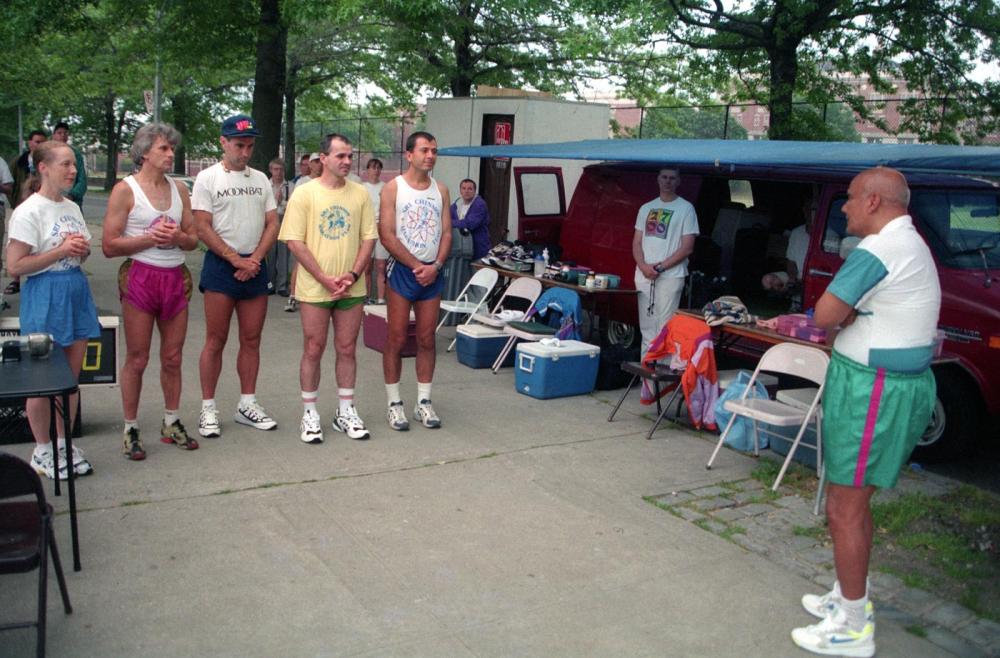
At 6:05 am on Thursday, June 12, 1997, five runners stepped up to the starting line on the sidewalk near Thomas Edison Vocational High School in Jamaica, to try and circumnavigate a slightly more than half-mile (.5488 miles or 883.2079 meters) course 5,649 times. The first annual Sri Chinmoy 3100 Mile Race was to begin on the same course that the 1996 event had five runners reach their goal of 2700 miles. Three of those lucky five were back to experience their own escape from the humdrum world. They had 51 days to complete their journey.
A race designed for runners with high mileage capabilities and fast recovery, the 3100 had an evening curfew from midnight to 6:00am. The rest of the time you ran your best. You had to be a master of mileage to even think of starting: 60.78 miles per day was the required average. Fifty miles a day kept you in the race. This was perhaps the longest race ever done on a closed course; certainly the longest race available nowadays. The runners slept in apartments near the racecourse, and brought everything they needed for each day. Meals were delivered at regular times each day, and a constant supply of liquids and snacks was available. When they finished at night, a car whisked them away to home for rest.
The Runners
Edward Kelley, 39, was a part-time actor and former track coach living in Long Beach, California. "I came to win this thing, I'm determined to finish, and I expect to average close to 70 miles a day," he said. Kelley had finished second in the 1996 2700 Mile Race, trailing Latvian world record holder Georgs Jermolajevs by over 100 miles. "People ask me why I do these races. I tell them because I am good at it. I love to race and compete. Obviously the distance scares people. But I have run across the country five times, had two non-finishes, plus ran 2700 miles last year. I know I can do better. The 3100 distance intrigues me and inspires me."
Georgs Jermolajevs, 54, arrived from his native Latvia only 14 hours before the race began. Having endured another rough winter in the former Soviet republic, Jermolajevs was eager to begin his journey of 10 million steps, free of the constraints and pressures of his then-destitute homeland. The physical education instructor and odd-job worker claimed normal fitness, but hoped to be in top shape after a week or two of road toughening. The previous year he had run 2700 miles in 40 days 15 hours, averaging 66.7 miles per day to dominate the race.
Istvan Sipos of Hungary arrived amid rumours that he had not run a step since his victory in the 1000 Mile Race in 1996. Istvan took the offer to come to New York, hoping to run himself into shape while keeping the others within sight. In 1993 he had set the world best for 1300 miles and 2000 km, and many recalled his easy victory in the 1994 Trans America Race, when he glided through the hottest first three weeks on record and was never challenged in the 64-day stage race (3000 miles).
Suprabha Beckjord, 41, toed the line for her 20th multi-day race of five days or more in the last 12 years. She had been brilliant in the 2700, finishing first woman and third overall in 43 days, 0 hours, 46 minutes — an average of 62 miles per day. Fearless and confident, Beckjord came with her health and fitness intact, ready to push her limits again. She was the lone woman in the race, but a relentless competitor nonetheless. Her years of experience and great ability of concentration would surely propel her to the finish line.
Aleksandar Arsic, 32, from Nis, Yugoslavia, was the youngest runner in the field — limited in experience but showing good potential. He had completed four other multi-days but had never passed 903 miles. He would need to average at least 50 miles a day to stay in the race, and hoped the other talented four would pull his young legs along to new heights.
The Start
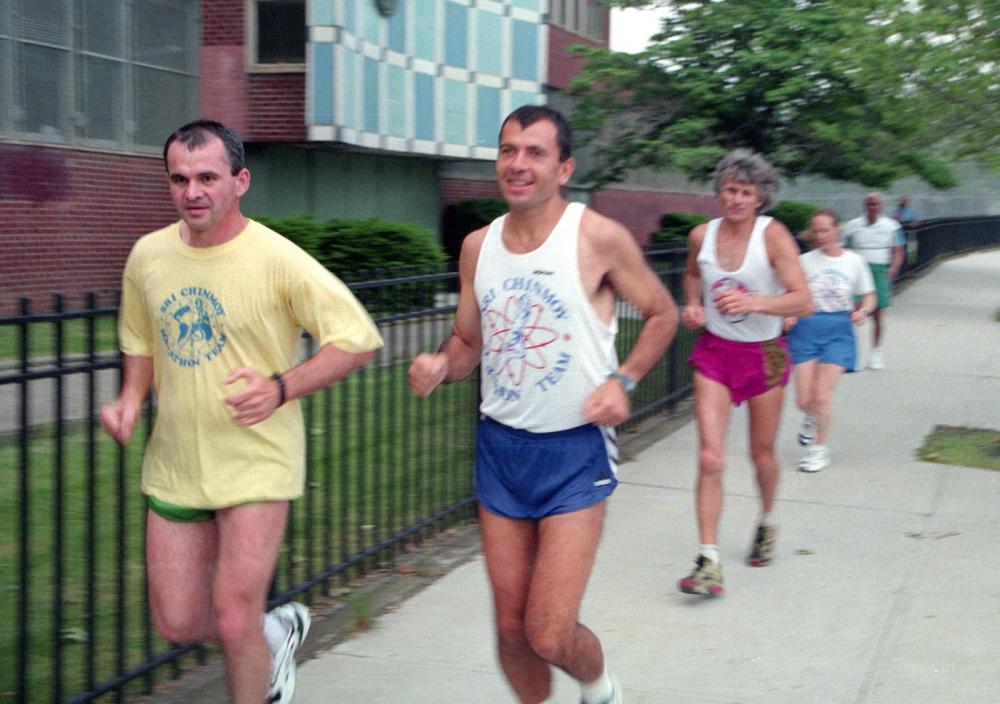
After a powerful silent meditation by Sri Chinmoy, the runners left the line in a clockwise direction around the concrete course.
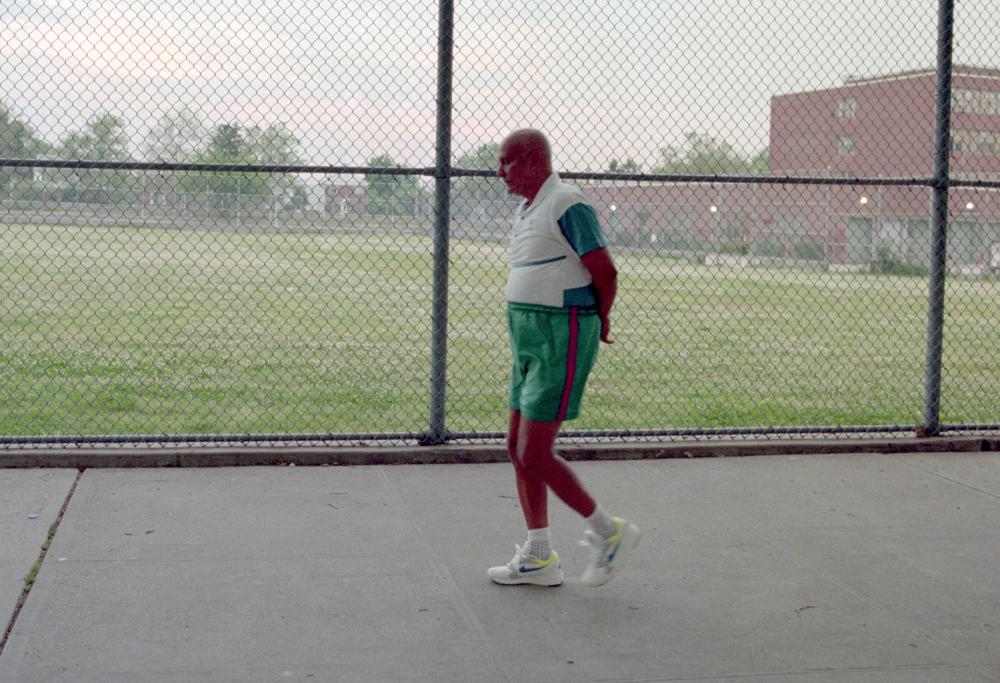
Ed Kelley took the lead from the gun, hoping to strike hard at his competition and set the tone for the race. Georgs ran and walked to stay close, but Edward widened his lead by the end of the first day. After completing 88.9 miles on day one, Kelley was nearly 12 miles ahead of Georgs, 17 miles ahead of Suprabha and 27 miles ahead of Istvan. But competition is not the only thing that a race of 3100 miles is about. Consistency, patience, poise and good health are the hallmarks of multi-day success.
The Early Weeks
As the miles began to pile up and days passed, one could notice the slimmer look of each runner. Effort showed on their faces, but cheerfulness still remained a part of their demeanour. They seemed to have a great awareness of everything around them — they were actually enjoying this race.
On Day 7, hot, humid weather moved into the region, with temperatures rising into the 90s. Unlike the unusually cool weather of the previous year, the summer began heating up quickly. After one week, Ed Kelley led with 485.6 miles (69.2 per day), firmly ahead of Georgs (454.4 miles), Suprabha (444.5) and Istvan (405.5 miles). Even Aleksandar averaged 56 miles a day.
Kelley had once remarked that you should expect two or three major crises during a run of this magnitude. By Day 11, Georgs — having fallen 40 miles behind Edward — had some mental struggles, stopping early one evening at 43.9 miles, saying he couldn't sleep in the heat. Istvan, meanwhile, suffered a serious right quadriceps injury; walking slowly and in great pain, he was forced to withdraw from the race on Day 12, a victim of a torn quadriceps muscle.
Ed mounted a counter-attack and by the end of two weeks had totalled 943 miles. But he was not immune to problems — breathing difficulties in the stuffy, humid air saw his internal temperature rise to 102°, with spells of dizziness and weakness. On Day 15 he barely made 50 miles, yet his resolve carried him through. One day Sri Chinmoy told Edward that a champion always shows his true colours. Kelley passed his first major test.
During the hottest stretch, Suprabha ran extremely well, recording the highest daily mileage in the field on four of the six hottest days. She slipped ahead of Georgs into second place, at one point drawing within 22 miles of the lead. Meanwhile, Georgs' Achilles tendon became tender, forcing him to adapt his footwear and lacing to allow the tendon to heal while he continued.
On Day 21 Suprabha encountered her own crisis — a slightly pulled muscle in her upper thigh. She walked the remainder of the day, still totalling 56 miles, but fearful of her long-term chances. Luckily the injury proved minor, and with a good night's rest she was back running the next day. This would prove to be her only day below 60 miles for the entire race.
What Drives Them On?
What made these runners continue when they had already covered thousands of miles, with thousands more to go? To even toe the line for a race of this magnitude is an act of courage. An ultra-runner is someone who can overcome fits of boredom, fatigue, discomfort and endless hours of running — alone with their thoughts, alone with themselves for days and weeks on end.
Suprabha often said she was exploring new boundaries of her inner self as well as her physical limits, using her meditation practice as a catalyst for discovering her true inner capacity. Ed Kelley used his charitable connections with children's disability as a stimulus to cover the miles and reach new goals. Their spirit is perhaps more remarkable than their talent.
The Last Three Weeks
As the race passed the four-week mark, the finishing order became clear. Edward Kelley and Suprabha Beckjord were destined to finish within the 51-day time limit. Ed passed 2000 miles in 30 days 14 hours; Suprabha followed at 32 days 3 hours. All the runners had to endure a typical New York summer — hot and humid, with little air movement and infrequent thunderstorms.
One particular storm on July 18th was a little too close for comfort. A heavy downpour in the afternoon was followed hours later by black clouds and red-tinted thunderheads. Within minutes the sky blackened, the wind shifted, and the full force of the storm broke loose. Suprabha and Aleksandar donned raincoats and continued running; Ed and Georgs took shelter in the vans. Branches and trees came down, hailstones clattered on the vehicles, and a large tree fell near the course. Winds reached 70 miles an hour, closing the two local airports, and a mini tornado touched down less than ten miles away. Yet still the two runners circled the track. Numbers from the scoreboard were found two blocks away.
Georgs began to put up more respectable numbers in the final weeks, learning valuable lessons about survival and acceptance even as victory slipped away. He passed 2000 miles on Day 36 — nearly six days slower than Kelley's split. Aleksandar, still in the race past the four-week mark, was quietly putting pressure on Georgs from behind.
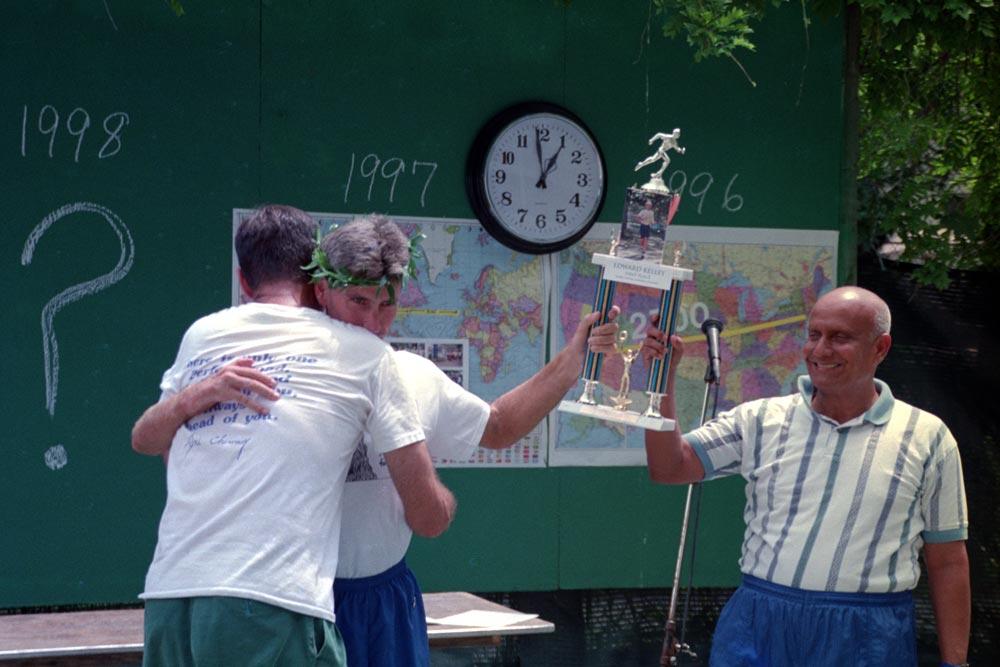
As the remaining quartet approached forty days, Edward Kelley was almost assured of victory. He reached 3000 miles in 46 days 6 hours — the first man to pass this milestone in a certified race. On Tuesday, July 29th, he became the first man to reach 3100 miles, finishing in 47 days 15 hours — 130 miles ahead of Suprabha.
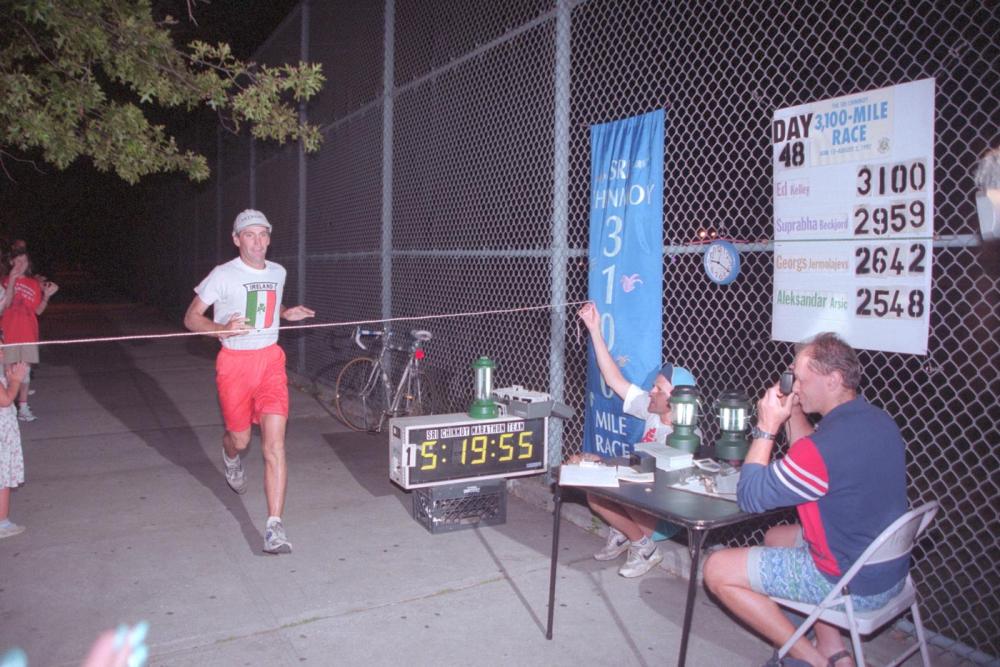
A crowd of nearly 100 people witnessed his historic triumph. Forty minutes after reaching 3100 miles, he returned to the course to record 13 more laps, passing 5000 km in 47 days 19 hours — three world firsts in a single race. He averaged 65+ miles per day for 47 days, his steely determination carrying him to the goal.
Suprabha Beckjord crossed the line on Friday, August 1st, completing 3100 miles in 50 days, 2 hours — averaging 61.9 miles per day. When she finished, friends showered her with gifts, bouquets and placards. A modest, humble and supremely talented athlete.
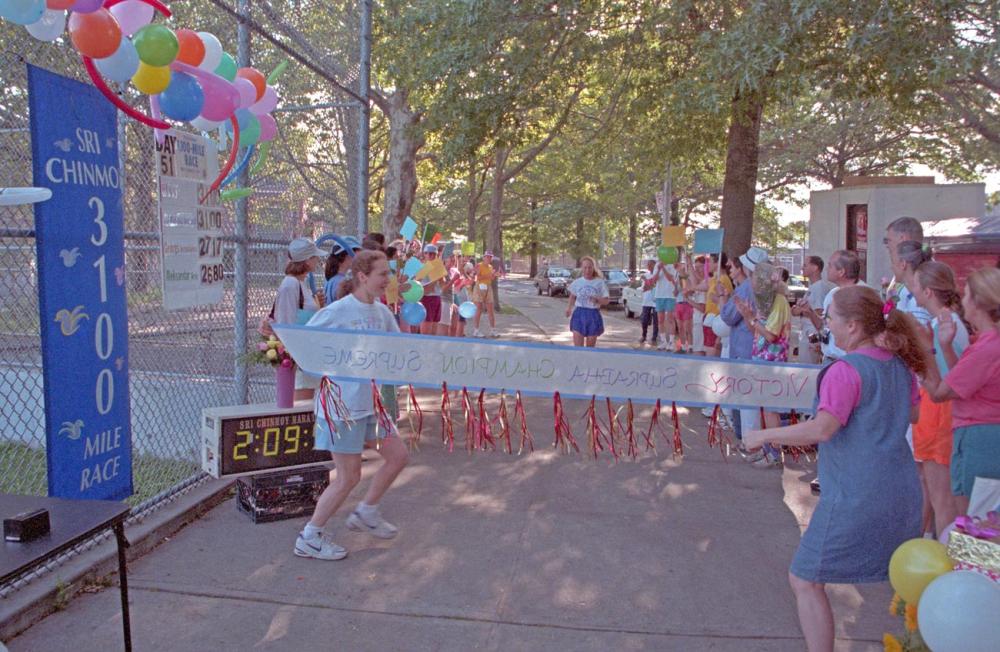
Georgs Jermolajevs stopped with 2717 miles — far from his own expectations, but much fitter than when he started. Aleksandar Arsic reached his personal pinnacle of 2700 miles on the final day, grateful for the experience and ready for the next challenge.
"Our philosophy is self-transcendence. Yes, there is no limit to our inner progress and outer success. But again, there comes a time when we reach a certain height, such an extraordinary height, that we feel we can live there for a good many years safely and self-givingly. Then we wait indefinitely for God's choice Hour to inspire us, to aspire in and through us to go forward, to embark on a new journey.
This 3,100 miles is an unprecedented journey in our world-peace-manifestation-dream. World-peace can come into existence only when we are inundated with patience and perseverance. Infinite patience we need in our inner life, and perseverance we need in our outer life.
"These 3,100 miles remind us of one divine and supreme reality: we can and must do everything at our command to transform the world of lethargy and unwillingness to be dynamic. Willingness to give, willingness to achieve, willingness to grow and glow should be the message of our souls.
"To Ed, Suprabha, Georgs and Aleksander, my soul's summit blessingful love, blessingful joy and blessingful pride I am offering unreservedly and unconditionally. Whenever I passed by you running, you reminded me of our souls' eternal, birthless and deathless journey and you reminded me of Eternity's choice runners."
— Sri Chinmoy, at the awards ceremony, 2 August 1997 (full speech)
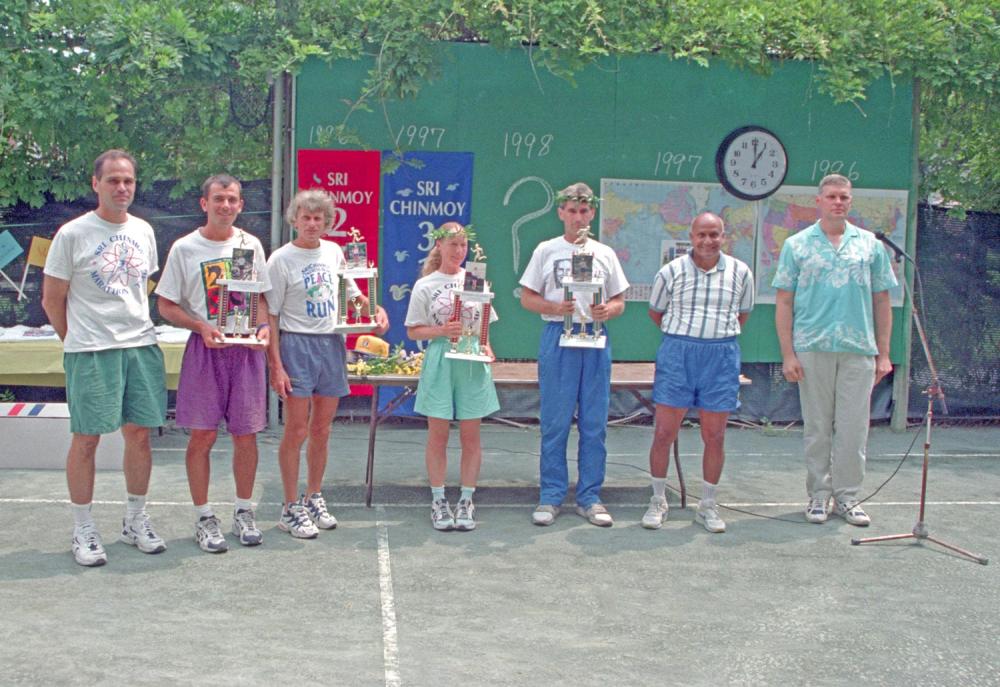
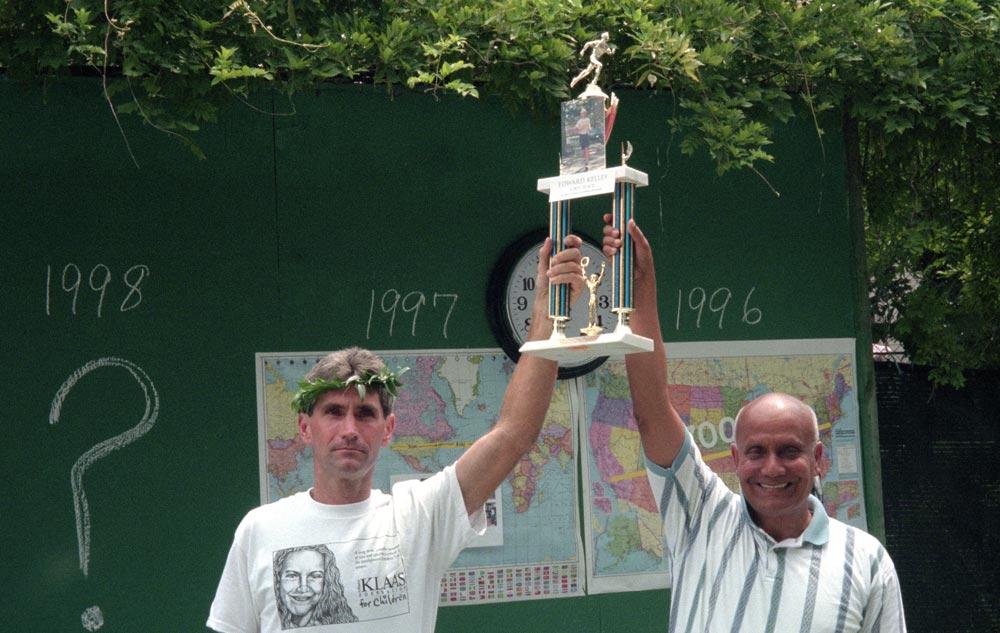
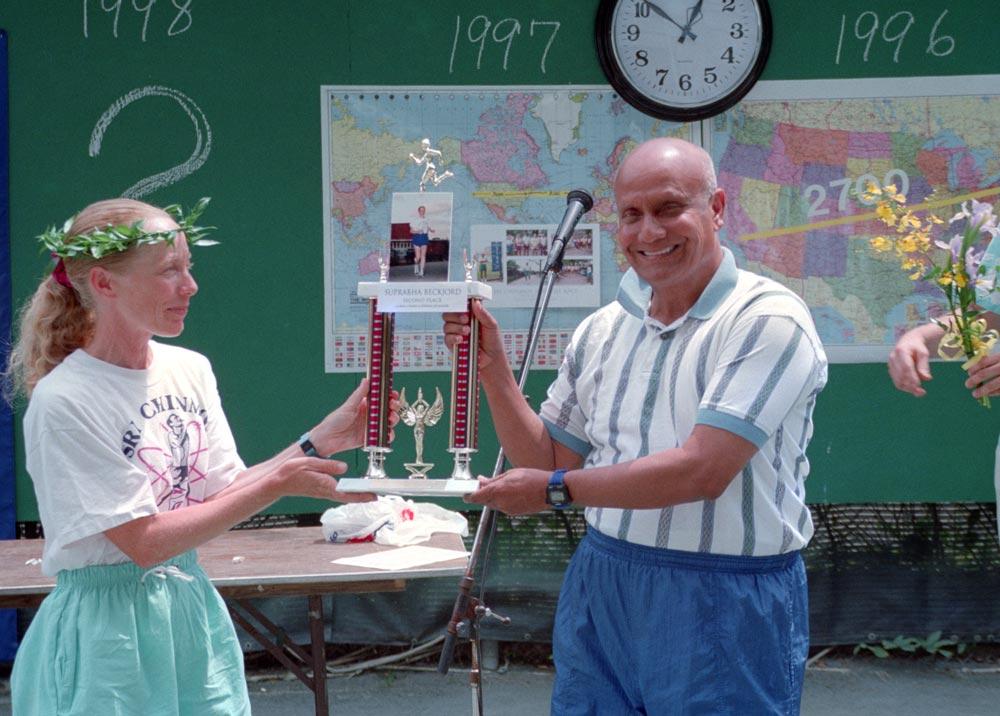
Photos from Prize Ceremony
Final Results
Sri Chinmoy 3100 Mile Race — June 12 to August 1, 1997 — 5 starters
Course: .5488 mile loop (883.2079 meters), paved sidewalk, certified
Curfew: 12:05am – 6:05am (Actual start: 6:05:00am EDT)
- Edward Kelley, 39, Long Beach, CA, USA — 3100 miles in 47 days + 15:19:56
- Suprabha Beckjord, 41, Washington, DC, USA — 3100 miles in 50 days + 02:09:56
- Georgs Jermolajevs, 54, Riga, Latvia — 2717 miles in 49 days + 13:15:26
- Aleksandar Arsic, 32, Nis, Serbia — 2700 miles in 50 days + 06:49:34
- Istvan Sipos, 37, Szeged, Hungary — 582.27 miles in 11 days + 00:59:05 (withdrew, injury)
A multi-day runner is always assured that when the race ends, he is never the same person that he was when he started. These lucky five runners had gone through ups and downs, never falling victim to doubt. As Sri Chinmoy often said: "Today's goal is tomorrow's starting point."
3100 Mile Race website
More articles about the early history of the 3100 Mile Race.