Remarks at the Home
of the Ramamoorthy Family
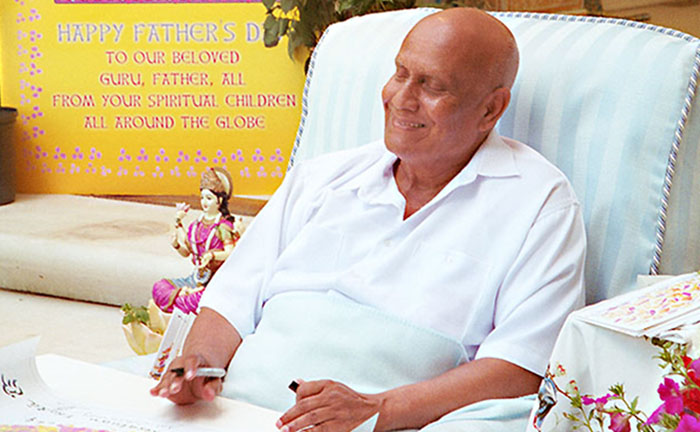
Sri Chinmoy and a number of his disciples visit the home of Mr. B. Ramamoorthy and Mrs. Lakshmi Ramamoorthy and their sons, Madhu and Raghu, where they enjoy a delicious dinner prepared by Lakshmi. These are excerpts from their wide-ranging conversation.
Mr. Ramamoorthy notes that, while he was working at the Indian Consulate in New York, he and his colleagues met the first batch of Peace Corps volunteers.
Sri Chinmoy: The Peace Corps started with President Kennedy. I love and admire the Peace Corps. The Peace Corps will save the world, not other corps.
Sri Chinmoy: On the birthday of the Prime Minister of Nepal, I was invited to his place. There was a big cake. He was on my left side and on my right side was a former Prime Minister. That former Prime Minister asked me right in front of the present one, “Please tell me how I can defeat him!”
We were in a small room. There were five former Prime Ministers. One of them said, “Please behave well — we are all Prime Ministers!”
Sri Chinmoy: For our concert in Philadelphia, we got a very nice audience. Quite a few people had spiritual experiences. They said that the atmosphere was very good and many other kind comments they made. From the spiritual point of view, they enjoyed it.
Sri Chinmoy: Boris Grebenshikov (Purushottama) has done something very great. He went very, very deep within and he got a few messages from his meditation. He received a few Sanskrit words and he set beautiful music to the words with the flute and other instruments. Where did he get the words? They are very, very good.
One of the Sanskrit words he could not hear properly. Now he has requested me to listen to the audio recording to complete the words. I have heard it four times. I will give him two words, so that he can choose the one he likes and complete his song.
Sri Chinmoy: I had a second sponsor who helped me come to America from the Ashram. She was very, very nice. Her sister lived in Baltimore. That sister came to see me. She said that if I did not get a job at the Indian Consulate, she was quite eager to have me in the big apartment building where she lived. Then she would make all arrangements for me to stay in Baltimore.
Luckily I did get a job at the Indian Consulate!
Sri Chinmoy: We have received the highest award from four or five countries. The first was Puerto Rico. Governor Colon is my brother. He made me an honorary citizen of Puerto Rico.
We have received nice letters of encouragement from previous Prime Ministers of India. The present Prime Minister I like very much because he is an admirer of Sri Aurobindo. When he became Prime Minister, he kept on his desk only Sri Aurobindo’s picture — no pictures of political figures. I saw the video on television.
[The Prime Minister of India at this time was Manmohan Singh]
Sri Chinmoy: When it is a matter of serving India, from upstairs the Supreme says, “Not yet — not now, not now.” India is not meant for the present moment. Let it grow and grow inwardly. When the time comes, I will definitely be of service to our Mother India. But right now, the Supreme says the time is not right.
Let Goa be the base.
Sri Chinmoy: When I went back to Chittagong after forty-five years [13 February 1986], the hotel manager would not allow me to go out shopping or to move around alone because I was a Hindu. He was a Muslim and he accompanied me wherever I went. Their cook liked me very, very much. He was very nice. He now lives in Connecticut! One of our disciples saw him where he was working and somehow they started talking. Then the disciple told him about me. He said, "I know him!” It was unimaginable! He came to see me at P.S. 86.
I went to see where we had our bank and so many other places. The hotel manager went with me. He would not allow me to go alone. Only when I went to see my village, he said it was safe. In the village there were two Ghose families. I went to the first one, but it was the wrong place. When I came to the second one, I was absolutely sure. I asked someone, but that person did not know my family. Believe me, my father was quite well known!
The inhabitants were wearing the Muslim lungi, so I was hesitating. I said to myself, “How can it be? These are my cousins. How can they be wearing the Muslim lungi?” I thought I had come to the wrong place, so I started going away. Then I mentioned my father’s name. Immediately, the lady of the house came up to me and fell at my feet. Still I felt that they had to prove it. I said to myself, “How do I know that this is our house?” They took me into a room. There they had kept so many pictures.
It was my desire to have some kind of monument in honour of my parents. My cousins were so happy and excited. They showed me a particular place where I could put a monument.
I went back to Pondicherry. Alas, my sister Lily was against the idea of a monument and my brother Chitta was also against it. Only Mantu did not mind; he was wide open. I said to myself, “What shall I do? I made a promise to my cousins.” Fortunately, I have good contact with the other world. I approached my mother and father in Heaven. They also were against it. Lily, Chitta, my mother and my father were all against having a monument. Why? It started with Lily. She said, “We shall not claim you any more. We shall not claim you — the world will claim you.” They all said that now I am a world-property, so they did not want a monument in our village.
I said, "I have so many disciples. They will come to see the monument and they will get such joy.”
They said, “No, America is now your home, not Chittagong.” They did not allow me to have a monument. My relatives in Chittagong felt very sad.
Then again, at the entrance of our little house in Pondicherry, my name is there. I have given that house to my dearest brother-friend Baburam. He gave me the money to come to America. I said to him, “Now, you take the house.”
One of our Indian disciples recently went to Pondicherry and Baburam’s family welcomed him. The disciple was so happy to see the marble plaque with the name “Chinmoy.”
The day before yesterday, Baburam called me just to chat. We talked and talked and talked. I said to him, “Are you going to keep my name on the house?”
He said, “Do I not know who you are?”
They will keep my name there. Baburam’s daughter Rama said that they will welcome people who come to visit Pondicherry. My name will be there, but in Chittagong there will be no monument to my parents.
East Shakpura! In size, it is smaller than Briarwood. Still, there is East Shakpura, West Shakpura and Middle Shakpura.
Sri Chinmoy: In Pondicherry I was a village boy, but over the years three or four Lieutenant Governors of Pondicherry have written such nice letters to me. One of them happened to be a direct disciple of the Mother and Sri Aurobindo. She became the Governor. She wrote me such a nice letter in Bengali.
Sri Chinmoy: I like the current Prime Minister of India.
My first meeting was with Prime Minister Morarji Desai. We talked about the Bhagavad Gita and he was very nice.
Once when I was travelling to a particular country, they said that I did not need a visa, so I did not have one. But when I arrived, they would not allow me to enter the country. I never carry any credentials with me. I had only a newspaper. In that newspaper was a photograph of me with Morarji Desai. I showed it to the official and he said, “Oh, your Prime Minister!” Then I did not need a visa.
Very briefly we saw Indira Gandhi in New York. The disciples were singing for her.
Narasimha Rao said such nice things at the United Nations. Afterwards we became very close.
Prime Minister Vajpayee was very, very nice. I met him in Bali.
[Prime Ministers of India: Morarji Desai 1977-1979; Narasimha Rao 1991-1996; and Atal Bihari Vajpayee 1996, 1998-2004.]
Question: When something is about to obstruct the divine victory that is destined, can your inner guards prevent the obstruction?
Sri Chinmoy: Sometimes the guards know that the divine victory is going to take place. When something seems absolutely certain, one may become relaxed. If a person in authority says that definitely he is going to do something divine, then what more can one do? Sometimes, unfortunately, I do not tell my inner guards what is happening.
When Sudhahota was competing in the Olympics, I made a prediction one day before his race. I kept all my inner guards fully informed and my prediction was fulfilled.
Sri Chinmoy: No spiritual Master has received the Nobel Prize. Sri Aurobindo’s The Life Divine was sent to the Nobel Committee. Everybody was sure that Sri Aurobindo would get the Nobel Prize. Then the Committee members said that they could not understand the book.
About twenty years ago, my brother used to take some of my books to Nolini, my former boss at the Ashram. Nolini said, "I am absolutely certain that Chinmoy will one day get the Nobel Prize for Literature, but not now. This is not the right time.” This was Nolini’s prediction.
My first boss at the Ashram, when I worked as an electrician, prayed every evening for years and years for me to get the Nobel Peace Prize. He said, “You deserve it and if you get it, then the ashramites and your followers will be so proud of you.”
Sri Chinmoy: In Tagore’s case, only one Irishman championed his cause and Tagore did get the Nobel Prize.
Sri Aurobindo and Tagore were very, very close. When Sri Aurobindo was in the vortex of politics, Tagore said, “Tie is the soul of India. All of India will listen to him.” Tie wrote two pages of most prophetic utterances.
After some time, Tagore came to see Sri Aurobindo in Pondicherry. They spent half an hour or more together. Then again Tagore said such nice things about Sri Aurobindo. He said that Sri Aurobindo had won his soul. Later, alas, their followers could not appreciate each other.
In the beginning, Tagore used to write to Gandhi. Tagore was the first one to declare Gandhi a great soul. Tagore was the one who called him “Mahatma.” And Mahatma called Tagore “Gurudev.” Tagore became Gandhi’s Gurudev and then everybody started calling him Gurudev, Gurudev. They became so close.
In the evening of Tagore’s life, his Shantiniketan was in need of money. When he was seventy-eight years old, Tagore wanted to dance in order to make money. Gandhi said, “No, you do not have to do that.” Gandhi had so many rich supporters. He gave money to Tagore. Like that, so many times Gandhi helped Tagore financially. Again, when Gandhi said that he would fast unto death if Jawaharlal Nehru did not listen to him, Tagore begged him to stop fasting. Gandhi did listen to him.
In the very evening of their lives, Gandhi and Tagore could not see eye to eye. I read six or seven of their letters. Previously, so sweetly, so highly they were appreciating each other. But in the very evening of their lives, there was no reconciliation.
Tagore and Swami Vivekananda were very close friends. Swami Vivekananda used to go to Tagore’s place. But when Swami Vivekananda became world-famous, their friendship ended. Then the songs that Swami Vivekananda learnt at Tagore’s place he could no longer appreciate.
An Irish lady, Sister Nivedita, had to beg Tagore and beg her Guru, Swami Vivekananda, in the evening of his life for reconciliation. They did listen to her and then both of them said such nice things about each other. Swami Vivekananda said, “If you want to know about India, then Tagore is the answer.” But, alas Gandhi and Tagore were not reconciled and Sri Aurobindo and Tagore were not reconciled.
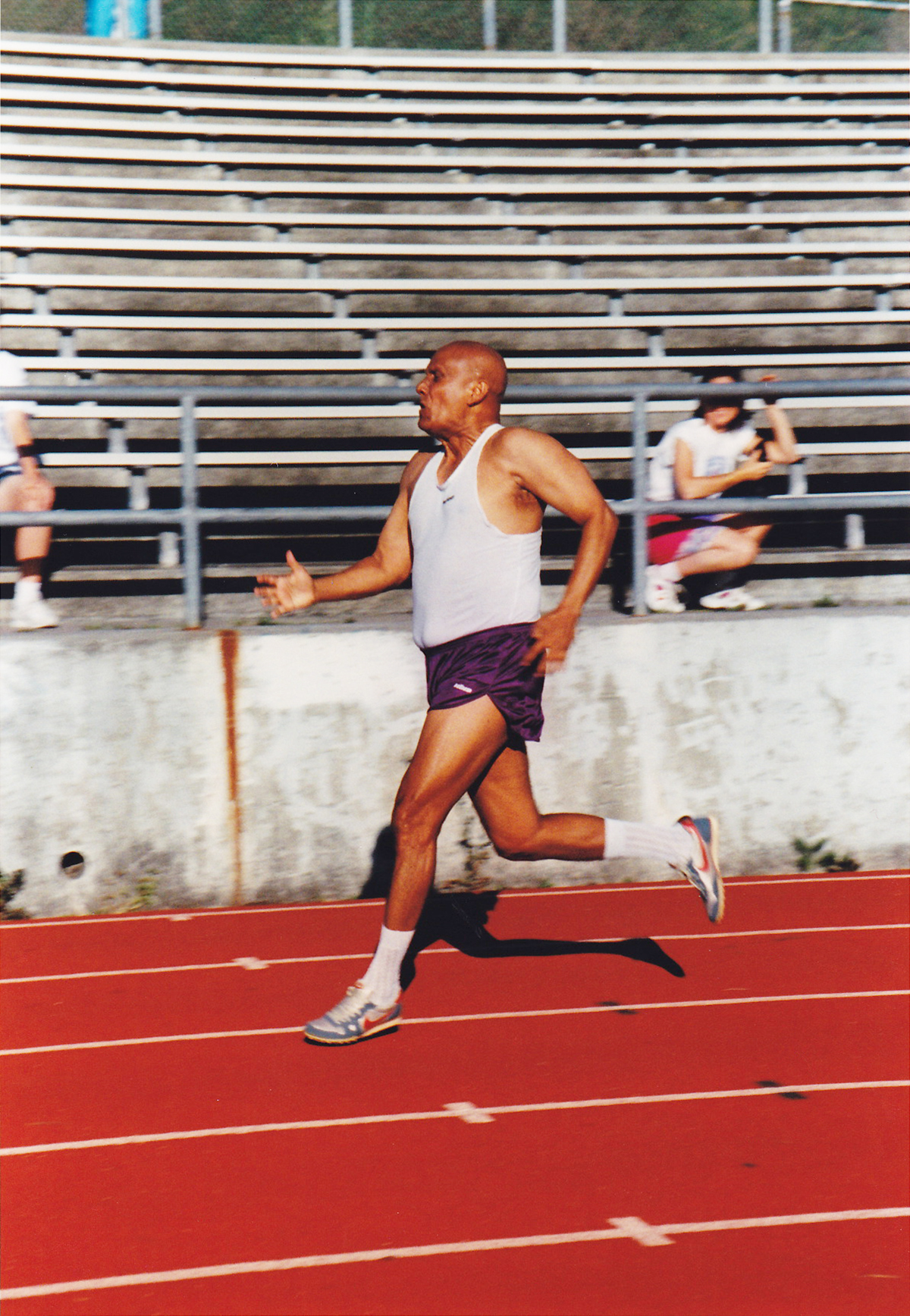
Sri Chinmoy: I first became fond of Goa when Lavy Pinto became India’s number-one sprinter. His time for 100 metres was 10:48. My time was over 11 seconds.
At the Sri Aurobindo Ashram, one of the main pillars was also named Pinto. His wife was in charge of opening the main Ashram doors.
The third famous person in my life from Goa was India’s number-one tennis player, Leander Paes.
Sri Chinmoy: Some great Indian figures lived long, but their friendship did not last. The saddest story is about Sri Aurobindo and C.R. Das. C.R. Das gave up everything, day in and day out, to save Sri Aurobindo in his political days. Then Sri Aurobindo said to C.R. Das, “If you want to realise God, you should be out of politics. Politics and God-realisation do not go together.” C.R. Das had been the greatest admirer of Sri Aurobindo, but he went away to follow another spiritual Master. This spiritual Master was like an anthill, whereas Sri Aurobindo was the Himalayas. C.R. Das became very devoted to the other spiritual Master. Then he begged and begged Gandhi to become the disciple of that Master. Gandhi said, "I admire him, but I cannot become his disciple.”
Sri Aurobindo’s brother was so close to him, but his brother left the Ashram.
Friendship does not last. Perhaps this message has come down from Heaven. This is the saddest story in my Indian life. One man was very wealthy. His family ran a business. They used to sell Indian ghee. He and his assistant were dearer than the dearest to each other. You have never seen such friendship! They were so devoted to each other. Everybody said, “How dear they are, how close they are to each other!”
Alas, the assistant fell in love and he started spending time with his girlfriend. He was neglecting his work. The friendship was dwindling and it ended in the most deplorable way. The assistant brought his boss to court and the boss lost. Finally the boss committed suicide. I have never heard such a sad experience. They were dearer than the dearest friends. The end of this friendship was so painful for me. Friendship stories we know end in different ways, but not in this way, with suicide.
Sri Chinmoy: I had quite a few friends in the Ashram. I must say, they were very dear and they were all my admirers as well.
When I returned to Pondicherry to visit the Ashram, I had to go to one friend’s place four times, only to say hello to him. He was in his room, but his servant would say, “He is not at home.” I could see that he was home! The servant was talking to him, but she would come to me to say that my friend was not at home. He did not want to see me, perhaps because I was no longer an ashramite and he thought that I had descended. Previously he was my dearest friend, my great admirer, but now he only wanted to see me through my window. Again, sometimes the shutters of my place were closed. Then he felt miserable, because he could not see me through the window. Four times I went to that friend’s place to see him. Previously he was so devoted to me.
The last time I said to myself, “Now, let him tell lies; I will go up.” I went up to his room. I wanted to sing for him two songs, the songs that I sing about the Mother and Sri Aurobindo. He was unwilling to hear my songs on the Mother and Sri Aurobindo. He said that there were other people in the house and I would disturb them.
What a painful experience! But I did not listen to him. Quietly I sang the songs in his room. Still nothing was happening. Then I said to myself, “This is too much for me. What can I do?” I left his room. I never expected him to follow me.
He did follow me and at the main gate I saw that he burst into tears. At the very last moment, he was crying, crying and crying a river of tears. That was Hriday Prasad. Next to Baburam he was my dearest friend.
When Mantu’s physical condition became serious, Hriday Prasad went to see Mantu. At one point when I called Mantu from New York, Hriday Prasad was there. I said, "I would like to speak to Hriday Prasad,” and he was so happy to speak to me.
In the case of Krishna Bhagaban, I lost him as a friend because he saw my occult power. It was too much for him. He said that I wanted to kill him with my eyes. You do not have to show occult power to lose friends. Other friends also I lost. This friend, Hriday Prasad, had been my great admirer, but later he was only eager to see my shadow in my own window. His house was very near mine. He waited for me to open the window so that he could see me. Finally he followed me, followed me, followed me to the main gate of the Ashram.
During my Ashram years, Hriday Prasad used to get tremendous joy by massaging my feet and my head. In those days I was already losing hair. They say that if you use lime juice to massage your head, you can solve this problem. I would be seated. With such devotion-devotion is the right word — he would stand behind me. That was the right time for Lord Krishna to come and see me, face to face! I was seated on my chair. Hriday Prasad was massaging me and he could not see Lord Krishna. God knows what language Sri Krishna and I were speaking. Both of us were talking. Hriday Prasad heard me, but he did not understand a single word. For about ten minutes or so, I was face to face with Lord Krishna while sitting on my chair and this fellow was massaging my head. I did not tell my friend to stop massaging my head, because I know how much love Sri Krishna has for me, no matter what I do. If somebody is massaging my feet, Sri Krishna will not mind. That kind of connection I have with Lord Krishna.
This boy who was massaging me was the same fellow who would not see me in later years. Our friendship was all over. Such a painful, painful experience! But again, he did believe me implicitly in those days. Such admiration he used to have for me.
Friends, friends! Once, while I was looking at the moon with a friend, Sri Ramakrishna was blessing me and talking to me. My friend could not see him and he did not hear anything. But Hriday Prasad did hear. He was hearing my voice, but he could not see Lord Krishna. Such friendship we enjoyed! He was such an admirer of mine. He was massaging and massaging my head with lime juice.
These stories are not my fabrication; they are not cock-and-bull stories in my life. This was Hriday Prasad.
Friendship, friendship, friendship!
Sri Chinmoy: There can be problems in the spiritual world!
Ramana Maharshi had a lady disciple who was married. Ramana Maharshi’s mother suffered so much because that lady used to put food in front of Ramana Maharshi. Ramana Maharshi was in trance; he was not in this world. One day, the mother became angry with her son. She left his place and said that she would not come back. She walked only two hundred metres. Then, what did she see? Her son, in his subtle body, stood in front of her so powerfully. Her son showed his spirituality. Then she knew that Ramana Maharshi was God-realised and she came back to her son. Previously she had scolded and insulted her son, but then she came back. Ramana Maharshi had that problem.
Sri Ramakrishna’s wife used to cook for him for years and years. At one point Sri Ramakrishna decided to examine his wife. Sarada Devi would cook, but he said that the food had to be brought to him by somebody else. Sri Ramakrishna would not allow Sarada Devi to bring him the food. Somebody else would bring him the tray and then Sri Ramakrishna would eat. She suffered so much.
There are so many questions that will remain unanswered. These kinds of problems started with Sri Ramachandra in the days of the Ramayana. How he tortured his wife! He knew that his wife was absolutely pure, pure, but people spoke ill of her. He made all kinds of sacrifices to please and satisfy his subjects. With Sri Ramachandra’s life all this misunderstanding began.
Sri Chinmoy: God is God, but for us, God is only God when He pleases us. We believe in Him only when He pleases us. When He does not please us, then God becomes an imaginary God.
Sri Chinmoy: Ambassador Siddhartha Shankar Ray was so kind, so kind. He said to me, “You are the real ambassador. We are ambassadors for four or five years, but you are the cultural ambassador. You will last!” He invited people to our Washington Peace Concert and we had about ten thousand people.
Sri Chinmoy: Politics as such is not bad, but I always say that some politicians can create problems. I feel that politics has a heart, but politicians are at times difficult.
Sometimes it is the assistants who create problems. At times the assistant prevents the boss from seeing someone that the boss himself wants to see!
Mr. B. Ramamoorthy: Where is God in a painful situation?
Sri Chinmoy: Where is God in a painful situation, you ask? Your name is Ram. For us in India, our first God was Sri Ramachandra, so you have to answer the question. Our first Avatar was our first God — there is no difference. An Avatar is a direct descendant of God.
I wrote an article many, many years ago entitled, “Where Is God?” In that article I gave all my “grievances” against God.
Ramana Maharshi said that movement is God. Then what was Ramana Maharshi’s answer to the question, “Is there a static God?” One is a dynamic God, in dynamic action. God is both action and inaction. In our philosophy we accept that God is both action and inaction. When He is the Doer, He is the work, He is everything.
Sri Chinmoy: I had very little connection outwardly with Ramana Maharshi, but twice I went to his place. The first time I went to see Ramana Maharshi, I was absolutely clean-shaven and I was wearing a lungi. I wanted to renounce the world. I was looking at Ramana Maharshi’s statue. It was so beautiful. On my left side I saw vividly the Mother and Sri Aurobindo, with tears! That was too much for me, so I came back to the Ashram.
The second time I was working for Nolini. Next to the Mother and Sri Aurobindo at the Ashram was Nolini. I had to be at his place by nine o’clock and again at two o’clock and he depended on me. I very nicely told my family members that I had received permission from the Mother to go to Ramana Maharshi’s place. What a wonderful story! Nolini did not believe it. Nobody believed me. I went to Ramana Maharshi’s place and then I came back. The following morning, my heart started palpitating. About forty selected people were supposed to go and visit the Mother at that time. Nolini did not say even a word. I was typing. Then Nolini came to me and said, “Mother is waiting for you.” Nobody else was there! I had to face the Mother. What a story I had told! I was at that time twenty-seven or twenty-eight years old.
I was standing two steps away from the Mother. She said, “So, I gave you permission?” She gave me an affectionate slap. Then she made a circle. She said, “You will not be able to go out of this boundary.” She wanted me to stay in Pondicherry only. It was three or four years later that I came out of the boundary, but she stood against it. She said she would not allow me to go to America. But inside me God said, “Go, go, go.” Nolini was simply furious! Inwardly, Amrita, the Manager of the Ashram, was for me. Outwardly he said, “Do not go,” but inwardly he said, “Go, go, go.” When there is eagerness, when the desire is so strong, that desire has the sanction from within.
On my last day in India, the Mother would not look at my face. One day before my departure, I was able to see her.
The third time I went to Ramana Maharshi’s place, they really liked me and they honoured me. Mantu also went there.
I will never forget the sweet slap that I received from the Mother for telling a story in her name.
Sri Chinmoy: For four or five years after I left the Ashram, the Mother did not ask me for anything. She thought that I had become a multimillionaire! But my sponsors said, “The Mother does want you to send her things.” Sixteen letters I received from her assistant, Dyuman.
Dyuman came to the Ashram with his wife. He was nineteen years old and his wife was sixteen or seventeen years old. They came to enjoy their honeymoon at the Sri Aurobindo Ashram. That was the right place! They thought that they would come there and become spiritual. Dyuman wanted to stay in the Ashram. Sri Aurobindo said, "I will accept you, but not your wife.” The wife cried and cried and she became so upset with Sri Aurobindo. Dyuman did not want to go back to Gujarat. He stayed at the Ashram and became dearer than the dearest. He was the one who used to write to me on the Mother’s behalf. He was very nice.
Six or seven items I used to send to the Mother from America. Dyuman told me that, three hours before she left the body, the Mother took eggnog that I had sent. The eggnog powder was a yellowish colour. In the container there was some powder left. Dyuman said to me, “You take it.” I said, “No, no, I know your devotion to the Mother and your love for the Mother. Please take it.” He kept that eggnog powder.
Pranab wrote a book about what the Mother ate. Pranab said that the last thing the Mother took from him was a kind of soup. Again, Dyuman, who was the Mother’s food minister, said to me that the last thing the Mother took was my eggnog powder. Whom to believe? One said that the Mother took eggnog and the other said that she took soup.
Sri Chinmoy: The Manager of the Ashram, Amrita, was all for me, secretly. After five years the Mother allowed him to write to me in America. He had been begging the Mother for permission. Then he wrote, “Today the Mother has allowed me to write to you. Are you not our Chinmoy? You have become a big shot!”
Amrita went to Sri Aurobindo’s Samadhi every day for three months to pray to Sri Aurobindo to take him to the other world. He did not get any response from Sri Aurobindo at the Samadhi.
One day he came at two o’clock and meditated. He prayed to Sri Aurobindo. On that day Sri Aurobindo sanctioned his request. He said, “Yes, I will take you.” Amrita’s two nieces, Saroja and Kumuda, were in the office. There were others also. Amrita came and told his friends, relatives and these two girls, “Chief has listened to my prayer. Tomorrow I will go to him.” Everybody laughed. Nobody took him seriously. But he said that he had received the message from the Samadhi that Sri Aurobindo would take him to the other world the next day.
At one-thirty in the morning he coughed very loudly. Nolini’s room was adjacent to his room. Nolini came to see him and saw that he was gone. That kind of connection Amrita had with Sri Aurobindo.
Sri Chinmoy: A seventeen-year-old boy came to Pondicherry to find a place for Sri Aurobindo. He was a great writer. I translated two of his stories. One was about an ugly woman and a blind man. The other story carried the message, “Who needs a woman?” This fellow was like Sri Aurobindo’s son. Sri Aurobindo was so indulgent to him.
One day when he was quite old, at around three o’clock in the afternoon he said to his friends, "Tomorrow you will not see me here.” Nothing was wrong with him.
His friends said, “What?”
He said, "I will speak to Chief.” They never used the name “Sri Aurobindo” — they always called him “Chief” or something like that. "I will speak to him tonight and I am sure he will take me.” Amrita had received a message from Sri Aurobindo that Sri Aurobindo sanctioned his departure. This man also meditated on Sri Aurobindo and Sri Aurobindo said that he would take him to the other world. When he told his friends, everybody laughed and laughed. He was lying down in his easy chair. He said, “All right, you will see tomorrow. Tomorrow after three o’clock, early in the morning, I will not be in the physical.”
When the time came, some curious people went upstairs to his room to see. Alas, he was no more. He did not take any kind of drug. He did not commit suicide. He was just lying down and he was gone.
That kind of connection Amrita and this man had with Sri Aurobindo. They knew that they would be able to contact Sri Aurobindo.
In Amrita’s case, it took three months or so. He was praying to Sri Aurobindo, but Sri Aurobindo did not listen to him. After three months, Sri Aurobindo listened to his prayers. He told everyone in his office that the next day he would be gone. At one-thirty in the morning, there was the sound of one cough. Nolini came to see him and he was gone. Amrita did not want to live on earth any more. He was satisfied, satisfied, satisfied.
In the second case, curious people came down to see whether the man was alive. They were planning to make fun of him, but he was gone.
Such a close connection these two had with Sri Aurobindo!
Visiting the Ashram
Sri Chinmoy: The first time I went back to the Ashram [March 1969] and visited Nolini’s place, it was beautifully, beautifully decorated. There were so many flowers. I had my camera, but it was written: “Photography forbidden.” With folded hands I was meditating. The man who was in charge of the room said, “Why are you not taking pictures?” I said, “It is forbidden.” He just grabbed my camera and took my picture.
Then to Amrita’s place I went. Everyone stood up and started clapping, showing me such affection. They were so fond of me.
The very last time I went to Nolini’s place, alas, alas, in his bedroom there was a television and a computer and all kinds of modern things. That was where I used to offer my worshipful service to Nolini.
I went to Amrita’s room. I used to work in his bedroom. I would write the Mother’s name. The name “The Mother” the bank would not accept, so under her signature I wrote, “Madame M. Alfassa, Madame M. Alfassa, Madame M. Alfassa.” The bank accepted it. Nowadays if you write “The Mother” on a cheque, the commercial bank and the state bank gladly accept it. But at that time I had to write “Madame M. Alfassa.” Then they would accept the cheques. Her signature alone they would not accept.
Coming back to the point, I went to see Amrita’s bedroom and I cried. It was full of big boxes. Some were opened and some were not opened. Nolini’s room was modern and in Amrita’s room there were all kinds of big boxes. I cried and I cried. Not only I, but all the ashramites, two thousand people, used to admire and adore Nolini and Amrita. Such a close connection they had with Sri Aurobindo. They were so close to Sri Aurobindo, both Nolini and Amrita.
The man who is now in charge of Amrita’s room has moved to a new place, a small place. We were very close friends. His name is Kalipada. He was Amrita’s assistant and I was Nolini’s assistant. There were four or five workers when I went to Amrita’s room. I looked at one of them and said, “Please tell me, where is Kalipada?” He looked at me and said, “Chinmoy, you cannot recognise me?” Then he made me see who he was. With such affection he spoke to me. Before, I could not recognise him. This was Amrita’s assistant.
Everything is completely changed.
With my brother I went to the playground, where I had been a champion runner. The man in charge would not allow me to take a picture of the playground. My brother was shocked. I lived for two years by the side of the playground, fifty metres away. The man said that I had not taken permission from Pranab, who is the director of physical education. Pranab is so close to me! This man said that I had to get written permission from Pranab to take pictures of the playground, where I used to run. Then I went to Pranab’s assistant, who is very close to me. He will now become the director of sports. His name is Gangadhar. He wrote, “Chinmoy can take pictures any time,” and Pranab signed it.
Again, there was kindness. I went to stand in line to see Sri Aurobindo’s room. They said one could not go to Sri Aurobindo’s room without the written permission of one person, Bansidhar. I went to him for his written permission. He said, “You need written permission? Go, go! Let me see who can stop you!”
Two or three boys came up to me and said, “Chinmoy, you do not have to stand in line.” It was a big line. I went to the front and said to the man who was in charge, the head guard, “Bansidhar has not given me written permission. What am I going to do?” He just grabbed me and brought me into Sri Aurobindo’s room!
There were a few people there. With folded hands I was looking with such devotion. One of the guards inside the room opened up my palm and put some flowers in it, because I had not brought any flowers. Then again I wanted to go into my highest consciousness, but in a few seconds another guard came up. He had to put flowers in my hand because the other guard had done it!
Then another man came up to me and said, “Sit down here. Meditate as long as you want to.”
I said, "I cannot sit.”
He said, “Oh, you are a big shot! Then stand. Go and stand there and meditate as long as you want.”
One of the guards saw me meditating and others came to know that I was meditating in Sri Aurobindo’s room. Such nice treatment I got! How much affection they have for me!
There are always two sides. One person would not allow me to take still pictures in the playground. He would not allow it, because it was a rule! Again, in Sri Aurobindo’s room they showed me such affection.
Now most of my friends are gone. They have left this world.
Use Occult Power, Lose Friends
Sri Chinmoy: One fellow named Krishna was very, very nice to me and he was so fond of me. I used to call him affectionately Krishna Bhagaban, Krishna Bhagaban. He encouraged me tremendously. He was very, very, very kind.
The Pondicherry High School used to have a boxing competition. I said, "I am not going to participate."
He was a boxer. He said, “You have to join! Just throw one punch.” I said that with one punch he would have been able to take me to God and then I would not have to do sports!
He laughed and he did not insist that I compete in boxing.
He was the friend who criticised all spiritual figures. He said, “Nobody has occult power — nobody! They are all fake!”
I said, “Do not say ‘all’. Some do have occult power.” He would not listen.
I said, “Come tomorrow morning. Then I shall show you.” He was a wrestler, stronger than the strongest. I met him in the international library. I said, “Stand here, against the wall.” I thought that, in case something happened, he would fall against the wall and there would not be any problem.
I used a little occult power. I think it took three seconds or four seconds. Alas, instead of falling against the wall, he fell on me, on the ground. For a minute or two he was unconscious, or God knows what happened. Then he stood up and said, “Rascal!” Two blocks he went running to tell Pranab his story.
Previously he was such a great admirer of mine and for him I was Chinmoy-da. Now I was no longer Chinmoy-da. He said to Pranab, “Chinmoy wanted to kill me!”
Pranab said, “How could he? You are so strong!” Krishna said, “No, no, he wanted to kill me!”
Pranab asked, “What? How? Did he have a gun?” “No.”
“Did he have a knife? What did he have?”
“Nothing, nothing.”
Pranab asked, “Then how could he kill you?”
Pranab was there with Gangadhar, who was going to be the future sports director. There were so many other people in the office. Then Krishna said that it was my eyes: I wanted to kill him with my eyes. I did not have a gun, I did not have a knife — nothing, nothing! My eyes were enough. “With his eyes, he wanted to kill me,” Krishna said.
Everybody laughed. About a month later I went there and they were telling that story. It was like an amusement park. They said, “Chinmoy, show us your eyes!
I said, “You can see my eyes, you can see my eyes! These are the eyes that Krishna Bhagaban saw. There is nothing, absolutely nothing in my eyes.”
They asked, “Why did it happen?”
Over the years I went to the Ashram quite a few times. When Krishna saw me in the street, he practically used to run away. He would not look at me. This was how I lost his friendship. Eventually he left the Ashram.
My Ashram stories are at times so funny and at times painful. Use occult power only to lose friends, lose friends, lose friends.
Use Occult Power, Misuse Occult Power
Sri Chinmoy: If you misuse occult power, you can lose everything.
A great occultist came to the Sri Aurobindo Ashram and hundreds of ashramites went to see him. He would look at your forehead or read your palm and he would be able to say things about you. Then you would pay some money. My dearest friend Baburam went to see him. Everyone was very satisfied, because he was a great occultist. Then my dearest Baburam started begging and begging me to go and see this man. Hundreds of people would be going. It would be a big event. I said, "I will not go, I will not go. I do not need to meet with this yogi-occultist.”
At Baburam’s repeated request, finally I did go. He was so nice to me, so I said I would go in order to please him. I stood in a very long line only to please my dearest friend. I think a hundred people were ahead of me. Baburam was right behind me. The occultist was sitting in a small room. They kept the door a little open. The occultist would read your head or your palm.
Finally my turn came. As soon as the door opened, the occultist stood up. He said, "I had occult power. I had it, I had it, but I have lost it all to drinking and women.” He said this in front of me! He stood up and said that by drinking and by mixing with women he had lost his occult power. My friend was behind me. Again I wish to say that, if you misuse occult power, you can lose it.
This fellow was an occultist and he pleased so many people. One day he decided he would walk on water at six o’clock in the morning. Thousands of people thronged to see him. They were all eager. As soon as he started to walk, he sank. Then he started blaming the sun. He said that the sun did not help him. These are my cock-and-bull stories!
Here in New York there is a fellow who said that he walked on water. He showed photographs. He is a joker!
My father wrote to his cousin saying that he would be responsible for his cousin’s business and would meet with all his expenses. This particular cousin was a rogue who misused all his funds. He was trying to take advantage of my father’s kind and generous offer. Finally there was a court case. From our village it went to the Chittagong High Court. It was the last day. My father’s postcard to his cousin was with the lawyer. My distant uncle was a yogi and a great occultist. My mother had tremendous devotion for that uncle. He was very close to our family and he lived about three miles away. My mother went to his place crying. He sent a courier saying, “Nothing will happen. I will do something.”
In the court, the lawyer was so happy because my father’s signature was on the postcard. He brought the postcard to show the judge that my father was responsible for his cousin, because he had promised that he would give him money. Even that morning the lawyer had been so thrilled to see my father’s signature. But when he showed the postcard to the judge, there was no signature. All the words were there, but my father’s signature was missing! It was done in a Chittagong village, three miles away from our place. We won the case. Then the judge asked my father to write something. My father was smart — he signed his name in a totally different way.
How can you deny occult power?
And what happened in the court? My father had a friend. My mother used to cook and do everything for my father’s dearest friend. He went with my father to the court. Then he changed his mind: he took the side of my father’s enemy.
Soon afterwards this man died. Look at my father! This man’s son was completing high school and his daughter was in college. My father paid for both of them, the son and the daughter, to finish their studies. My mother was dead against it, but my father said, “What can you do?”
Again, my father’s signature disappeared. The occultist did something from a Chittagong village three miles away from our place. He also used to make predictions. Everything came true. Then he saw that he had no time to meditate and devote himself to Mother Kali. He cried and prayed to Mother Kali to take away all his occult powers. But Mother Kali just advised him to say everything wrong. He knew where the stolen cow was; he knew what had happened. Before, he used to say everything correctly. He knew what was true. Then he started saying everything wrong, wrong, wrong. People stopped coming to him and he was able to pray again.
Not Interested in Becoming a Guru
Sri Chinmoy: What did this occultist do on his wedding day? He was supposed to travel with his wife on a palanquin. When he saw his wife on the palanquin, he said to himself, “O my God! I am entering into ignorance.” He believed in maya. He said to the palanquin-bearers, “I have to respond to nature’s call,” and they brought him down. Then he ran away and he did not come back. There his marriage ended.
He went to Calcutta and there he had disciples who were so devoted to him. When he left the body, they begged and forced his wife, who had never prayed and never meditated, to become their spiritual mother. She did not care for the spiritual life. She said, "I am the wrong person.” But they said, “No, we shall only worship you.” They had been practising spirituality and they started worshipping her. She had never practised spirituality, but she became their Guru.
There is another story like this. A great professor came to India from England. The president of a university invited him to a gathering. As soon as he saw the president’s wife, the professor felt that she was God-realised. She had never prayed, but he started worshipping this great soul. What an embarrassment! She was a housewife who did not pray and meditate at all. The president saw that the professor was very sincere and he himself started worshipping his wife. The professor was far advanced. Finally the wife started praying and meditating and she became his Guru.
This professor came to the Sri Aurobindo Ashram. His Indian name was Krishna Prem. Sri Aurobindo said that his third eye was open. The president’s wife never prayed, never meditated, but he saw her divinity.
Like that, my uncle’s wife did not pray. She did not want to pray or meditate, but his disciples forced her to accept them. They brought her to Calcutta. Then she became their Guru.
For these two the role of a Guru was unwanted. They were not interested, but they became Gurus.
Successful on the Fourth Attempt
Sri Chinmoy: In all sincerity I wish to say that, in my 7,000 lifts, I did not have any problems lifting anybody, except for one person. In Germany, three times I failed to lift someone. What an embarrassment! Poor fellow, three times I could not lift him. Then I invoked occult power and the fourth time I lifted him quite easily. What was I doing? I do not take four times to lift anybody. Always I lift on the first attempt.
When You Go Very High
Sri Chinmoy: I forgot my name many, many times. After coming down from the highest meditation, I completely forgot my name. Then I had to ask my friends my name and they laughed. Two or three times I had to look at a notebook. In school we had to write down our name on our notebook. In the Ashram my name was only “Chinmoy.” I had to search for my name. I looked at the notebook and then I remembered my name.
This is forgetfulness. It is quite difficult! I forgot my name so many times and I had to go and ask my friends. But they were so kind to me. They were full of admiration. Again, my notebook saved me two or three times by showing me my name.
Four or five times I came out of the house with one sandal on and one foot bare, walking very nicely. My friends asked me, “What is this?” Then I had to go home to get the other sandal.
Another time I ate at the Ashram dining hall. There was a place where we had to leave our dirty plates. After finishing eating, I left the dining hall and entered into a park across the street, while still holding my tray. A friend said, “What are you doing here? Then I went back to return my tray.
When you go very high, you forget everything.
So Difficult to Touch this Earth-Consciousness
Sri Chinmoy: Sri Ramakrishna used to have high experiences. Then, in order to come down, he would touch Brahmananda’s quadriceps or some other part of his body. Sometimes the disciples would give him immediately something to smoke. By smoking, he used to bring his consciousness down to earth.
Once in Canada I gave a concert and my consciousness went so high. The concert was over, but I could not come back to the earth-consciousness. I said to myself, “How am I going to come back?” I looked to the side and I saw Kanan. I placed my hand on Kanan’s shoulder and immediately I came back to this world. Before that, absolutely I could not come down. It was so difficult to touch this earth-consciousness. Then I saw Kanan and Kanan saved me. Immediately I came back. Sri Ramakrishna had that problem quite a few times.
There will be people to make fun of you, to say that you are pretending, but it happens to all spiritual Masters. It is absolutely, absolutely true. They find it difficult to come back to the earth-consciousness.
Stopping the Heartbeat
Sri Chinmoy: One magician recently wanted to stop breathing for seven minutes, but he did not succeed. Spiritual Yogis can easily do it.
Shyama Charan Lahiri was something! He stopped his heart. One of his disciples was a doctor. The disciple said, “It is clear that he is not alive.” Then Lahiri smiled at him and said, “Look, this is your medical science! Now feel my pulse.” The doctor did not find any pulse. Lahiri said, “Now look,” and he smiled at his disciple.
One particular tree is still alive in the park where I used to go to meditate. That was where I told my friend, “Do not say that all spiritual people are fake if they say that they have occult power.” I have taken so many pictures of that tree. Each time I go to Pondicherry, I take a picture of that huge tree in the main park in front of the Governor’s palace. During my Ashram days I sat there. At that time I could sit very easily. From time to time, not every day, I used to go and sit at the foot of the tree to pray and meditate. One day I saw some cars and rickshaws only thirty or forty metres away in the street. I got a peculiar idea. I said, “Indian yogis all say that they can stop their heartbeat at their sweet will. Let me examine myself and see if I can do that.” I cannot remember how old I was. I saw that my heartbeat completely stopped. I had at that time a stopwatch that I used for running. Believe me, I did it! I did stop my heartbeat.
Nowadays, every time I go to Pondicherry I sit at the foot of that tree and I ask my rickshaw driver to take my picture. I know what I did at that place. The last time I could not sit, so I stood at the foot of the tree.
I requested the driver to take my picture. Why? Because there, at that particular tree, I did something. It was not a trick and I was quite successful. I know why I am still so attached to that tree.
I did it once again when I returned to the tree. I used only thirty per cent of my capacity and it was not for as long as I did it the first time. The first time I was examining myself to see if I did have that capacity. The second time I stopped my heartbeat for a very short time. All these things I did.
Physically I am seventy-five, but spiritually I am very old, very old.
Taking My Soul Outside of My Body
Sri Chinmoy: About thirty-five years ago, one day an unusual idea entered into my mind. I gave my camera to a disciple and said, “Right now I am going out of my body. I am taking my soul out of my body.” The disciple took a picture when my soul was not inside my body. In that picture it is very clear. I took my soul outside my body, but it remained in the same room. The soul had not gone anywhere, only it was not inside my body.
Another time a disciple was extremely eager to see my Rudra-power. It is the worst possible occult power to show. It took only three or four seconds. The disciple screamed and screamed! Rudra-power is the worst. The destruction-power of Rudra you can call the thunderbolt of destruction. I do not think for more than three or four seconds you will be able to look at it. Then you will say, “Stop, stop, stop!” Perhaps I still have that power.
Requests for Help
Sri Chinmoy: Whatever occult power I had in India, believe me, I have not lost anything. Multiplication has taken place, I can say. There is not a single day that I do not use occult power. In the inner world I hear calls for help, help, help, help. In the inner world nobody knows what is happening and nobody gets the credit. Occult power can help easily.
Some spiritual Masters request me to help their disciples. Those spiritual Masters are in Heaven and I am on earth. They beg me to help their disciples because they feel that I will be more effective on earth, since I am in the physical. That is so true.
So many times it has happened that other Masters have begged me to go and help their disciples. I do help them and they do not even know it. They do not see me. They see their own Master, not me. I am an instrument, but I hide. Then they are so grateful to their Master. Their love, devotion and surrender increase tremendously because still they have their direct connection with their Master. Their direct connection goes through me.
Many years ago, when I was working at the Indian Consulate, a spiritual Master came to me. He was very displeased with his disciples. His request was that I should go and take care of his ashram. I said, "I cannot do that.”
I went to Vancouver. At that time a lady from Jamaica, West Indies was head of our Victoria Centre. That lady came to see me. A disciple prepared food. Then, on the inner plane, a spiritual Master of the highest order came to see me. We were about to eat. The spiritual Master wanted to tell me something. I said to him, “Now I have to eat.” For ten minutes he pleaded with me in the inner world to take over his ashram. It was in another state, not New York. He said that he would help me in every way. How he pleaded with me! He said that he would help me and he would give me his occult power and spiritual power. I said, "I have enough occult power and spiritual power. I do not need any more.” He was very displeased with me, because I did not listen to his request. But in so many cases I did listen to the requests of other spiritual Masters.
These are my cock-and-bull stories!
Taking Away Occult Power
Sri Chinmoy: Some occultists are so bad! When one occultist is fast asleep, another will come and take away his occult power. Then he will hide. This has happened many times in India. One occultist will take away the occult power of another occultist.
Sri Ramakrishna also did that, for an individual’s own good. One fellow used to show light in his back while walking at night. Sri Ramakrishna took away that power. Then the occultist became absolutely furious. Sri Ramakrishna said, “For your good, for your good I have done it. Now perhaps you will pray to God.”
Sri Aurobindo’s brother left the Ashram to develop some occult power. At night he turned off the light. Then he said, “There should be no light — nothing, nothing, nothing.” In the dark, from his back, he brought forth light and people took a picture. When Sri Aurobindo came to know about it, he took away his brother’s occult power. That younger brother became furious. He said, “You have such huge, huge fish! I have got just a little fish.” Sri Aurobindo said, “For your good, for your good I have taken it away. Otherwise, you would not pray and meditate and here your spiritual journey would end.” For his brother’s own good, Sri Aurobindo took away his occult power.
God-Realisation in Six Months
Sri Chinmoy: Many years ago, some of my disciples thought that they would attain to God-realisation in six months. In the Sri Aurobindo Ashram there was the same problem. One fellow got his Master’s degree, but for his PhD he wanted to go to Oxford. He wrote to Sri Aurobindo, “How long does it take to realise God?” Sri Aurobindo did not answer, but his brother answered, “It takes only six months to realise God. If you are sincere, it takes six months.” This man said, “Six months? Let me realise God first. Then I will go to Oxford to get my degree.” Instead of only six months, for fifty or fifty-five years he lived at the Ashram. He was very scholarly and kind-hearted. His job was to wash bananas in a big container. They used to put something red into the water and then wash the bananas. My brother Chitta was another one who washed bananas. They worked together. That fellow did not realise God. He stayed at the Ashram for fifty years instead of six months and he did not go to Oxford to get his PhD.
When my eldest brother had his first meeting with the Mother of the Sri Aurobindo Ashram, he said, “Mother, I believe some people have come here after realising God and some people will realise God in this incarnation.” The Mother said to him, "I cannot tell you about the ones who have realised God, but I can tell you that you will realise God in this incarnation.” He would realise God in this incarnation! My brother was so happy. He told everybody. Then, after twenty years or so, he reminded the Mother. He said, “Mother, you told me that I would realise God.” The Mother said in writing, “There is no hope for the idle. God-realisation is not for the idle.” I cannot remember the exact words. That is how my brother’s God-realisation in this incarnation ended. My eldest brother, Hriday, used to pray and meditate seven or eight hours a day, but perhaps he did not please the Mother in the Mother’s way.
Showing Occult Power in My Family
Sri Chinmoy: My first display of occult power was with my cousin. She was so kind and affectionate to me. I went late to eat at her place and she was scolding and insulting me to her heart’s content. She said that if I came late next time, she would kick me. I said, “Show me how you will kick me.” She raised her right leg and then it would not go down. Luckily she was holding on to a pipe. She told this story to so many people. Then what happened? My sister Lily came to know. She was enjoying the whole comedy. She believed it and she enjoyed it. Then came my eldest brother. It was too much for him! He started scolding me. My cousin and I were so close. How could I do this kind of thing?
It was almost evening. Eight hundred metres away from our house was a paddy field. The farmers were still working. I said to my brother, “Please come with me.”
He asked me, “What for?” He was still upset with me.
I said, "I will show you something. “What is it?”
I said, “Some farmers are still working and I will show you how I can transform one farmer into a lamb. Then I will again transform him back to a farmer. He will not die or suffer any injury.”
My brother scolded me and insulted me. Then he said, “You have studied occult power?”
I said, "I have not studied any book.” Then I remembered that our Indian almanac predicted what time it would rain and I told my brother. He said, “You can squeeze the almanac; there is no rain there.”
I said, "I have not studied from a book. Please come.”
He would not agree. This was how it ended.
How Different Everyone’s Fate!
Sri Chinmoy: In a family, how different everyone’s fate can be! My eldest brother was praying all the time and he died looking at the Mother and Sri Aurobindo’s pictures. In Chitta’s case, his God-realisation was guaranteed. I was his life-breath. One day, he and my sister were talking and talking. His work was over and he went out to walk. Lily also went for a walk. Fifteen minutes later Lily came back. She saw Chitta in front of her, lying down. His head was bleeding and he died. That was how his life ended.
Biren’s Vision
Sri Chinmoy: Another story is parallel. The poem Tomari hok joy was written by an ashramite named Biren Palit. It is so beautiful. I composed a famous song to that poem! Biren Palit was very, very dear to me. He was like a mentor to our family and he saved us a few times.
One night when I was in America, many hostile forces attacked Biren. They literally wanted to kill him. He was not thinking of them, but suddenly they came and they wanted to kill him. This is a cock-and-bull story! He saw me in my most luminous form and he said that I was Gorakshanath. As soon as the hostile forces heard the name “Gorakshanath,” they all disappeared.
This cock-and-bull story never ends! Biren came at around five-thirty to my sister’s place, because he had been saved after seeing my luminous form. Then he said, “Do you know who Madal is?”
Chitta said, “Who is Madal?”
My friend said, “Madal is Gorakshanath.” He narrated the whole story.
Then my brother Hriday said, “You know now, but I knew it long ago. One day during my highest meditation, I saw that Madal was Gorakshanath.”
My sister said, “If you knew, then why did you not tell us? Why did you not tell us?” Everyone laughed and laughed.
My eldest brother! I could have shown my occult power to my eldest brother, but he would not believe me. I said, "I never read any books about occult power. I never cared for occult power. I cared for the Upanishads. I liked the Upanishads.” I wanted to show him that I was studying! He did not come to see my occult power; he just said that I did not have that power.
Two or three times my brother wanted to leave the Ashram and Biren stopped him. He was like a mentor to our family. He always saved us, saved us. When the Mother passed away over thirty years ago, I had my picture taken with him. He kept the picture.
Each spiritual Master has not thousands, but millions of sweet stories — some that people believe and some that people do not believe.
My Way of Praying and Meditating
Sri Chinmoy Because of my eldest brother we all came to the Ashram. He came first, when I was one year and three months old. My father expected so much from him. My mother was crying. Then my mother started fasting. She wanted to go and see her son in the Ashram. My father said, “No, I will not allow it.” My mother fasted for a day and a half. Then my father’s heart melted and my mother was able to go to the Ashram and see her eldest son.
Prayers and meditations one can do. One can pray and meditate for hours and days and months and years and years, but jealousy can still enter! In this incarnation, I was no match for my eldest brother in praying and meditating for hours. I did walking, cycling and singing. So much of my meditation took place in the street. I did not sit down. But for the last seven or eight years of my Ashram life, somehow the Mother wanted me to meditate in Sri Aurobindo’s room. Then I had to sit down properly. Before that, I never sat!
I Visited You Occultly
Comment to Mr. B. Ramamoorthy:
Sri Chinmoy: Why was I asking the Annam Brahma workers again and again about your health? When you had a serious problem, I was asking about you, about you, about you! It was Christmastime and I was travelling with the disciples, but I was making enquiries about your health because your soul was coming to me to tell me about you. First you were all right and then you had to go to the hospital. I was in Bali and your soul came to me to tell me what was happening. I still remember how your soul came to me, telling me about you and outwardly I was asking what was happening.
Negative things can happen repeatedly. One after another they can come. One sad experience is not enough. It may happen that that sad experience is immediately followed by another one that is worse.
Somebody was seated in the hospital with you in the subtle body! I visited you in the hospital a few times, occultly. I still have that kind of love for you. Forever I will have love for you and my gratitude to you will always remain. New York and Bali are physically very far from each other, but your connection with me is very deep. When the soul-connection is so powerful, at that time there is no such thing as New York or Bali.
Songs about Mother Kali
Sri Chinmoy: When I sing some songs about Mother Kali that were not composed by me, but by others, I really forget myself. When I hear others sing them and also when I sing, at that time I appreciate them so much.
My Connection with Sri Aurobindo
Sri Chinmoy: My main song for Sri Aurobindo I sometimes do not sing because I am afraid that I will disturb the neighbours!
There is a miracle connected with that song. A few years ago I was in Pondicherry, in the Ashram. It was one o’clock in the morning. A piece of glass entered into my foot and I was suffering badly. My sister Lily was in the hospital and Chitta was downstairs. I said to myself, “How can I tell him what has happened?”
A very peculiar idea entered into my mind. Inwardly I said to Sri Aurobindo, "I am not going to sing my song for you any more unless you take out the piece of glass from my foot. So devotedly I sing that song and so devotedly people listen, but I am determined not to sing it any more if you do not cure me!”
This was all taking place in the inner world. I did not see Sri Aurobindo at all.
Then I said, “Tomorrow morning when I get up, there should be no piece of glass inside my foot.”
It was around one o’clock and I was supposed to get up at four o’clock, but all of a sudden I was compelled to get up. I literally jumped up. Believe it or not, the piece of glass was gone, completely gone! I came back to my bed and whom did I see on my table? Sri Aurobindo! This moment he was laughing; the next moment he was smiling. Here I had promised, I had taken an oath that I would never sing my song for Sri Aurobindo if the glass remained in my foot the next morning. It took only fifteen minutes! Will I ever forget that experience with Sri Aurobindo? This is my connection with Sri Aurobindo. Our connection is still quite strong. If he had not cared for me, he would have ignored me. He could have said, “Who cares if you do not sing my song?” But he did not do that. In fifteen minutes the miracle took place. The piece of glass went away. And Sri Aurobindo was smiling and laughing on my table. Such is his affection, such is his love, such is his concern.
Like that, I have had so many inner experiences with Sri Aurobindo and the Mother-many, many!
My Immediate Attention
Comment to Mr. B. Ramamoorthy:
Sri Chinmoy: Where is the proof when I tell my cock-and-bull stories? Where is the proof? Many things I will not be able to prove. They are impossible, impossible to prove! Many things nobody will believe.
Ten or twelve years ago, from your family, somebody’s soul came up to me for immediate attention. You will not believe it. It was around eleven o’clock at night. I cannot tell you the reason why the soul came. The soul expressed the wish for my immediate attention — “immediate” is the right word. I was able to be of service to that soul, with such affection, love and joy. That individual does not know about it and I cannot tell that individual. The soul came because it needed my immediate attention. Very distinctly I remember it. Outwardly the individual may not know, but the soul knows. That family member was in serious danger.
Blessings from My Elders
Sri Chinmoy: Those who were born and brought up in America are lucky! In India, when you become one year older, there is a special puja and you are compelled to touch the feet of your elders. Since I was the youngest, God knows how many times I had to touch people’s feet! There would be thirty or forty people whose feet I had to touch. I touched the feet of my father and mother, plus my relatives. We needed their blessings once a year. It was compulsory; I had to do it.
At the end of Durga Puja, always we had to touch the feet of our superiors, even if somebody was only one or two years older. In my case, I had a cousin who was younger than me. She was the only one who touched my feet. Others’ feet I had to touch. At the Ashram, I used to touch only the Mother’s feet and Nolini’s feet. Nolini’s feet I touched on very special occasions, on his birthday and my birthday. In the Mother’s case, very devotedly I used to place my head on her feet.
My eldest brother, about whom I was telling stories, blessed me so many times. Then, when I became a Guru, the same brother would not allow me to touch his feet. He would not allow me even to bow to him. He would not place his hand on my head; my shoulder was enough for him. How many times I had to touch the feet of my aunt, who died at the age of 103. In later years, the same aunt would not touch my head and she would not allow me to bow to her. I would just bend my head a little. She would grab my hand and say, “Bless me, bless me.” How the story changed!
I begged both my brother and my aunt to allow me to bow to receive their blessings, but they would not allow it. Touching my shoulder was their blessing. At that time it was too much for them to bless me on my head.
My Brother’s Last Prophecy
The last time I saw my brother Hriday, he was putting his hand on my shoulder. I said, “Why are you doing that?”
He said, “You have conquered the heart of America. One day you will conquer the heart of the whole world. Then you will be frustrated and you will come back to the Himalayas.” That was his last prophecy. After I conquered the heart of America and the heart of the world, then I would be so frustrated that I would come back to my Himalayan caves. In my previous incarnations I enjoyed the Himalayas, so my brother said that I would come back to India and live in the Himalayas. That was his last prophecy, which he uttered while putting his hand on my shoulder. I came back to New York from my visit and in twelve days he died, meditating in front of the pictures of the Mother and Sri Aurobindo. While meditating, he collapsed.
Touching a Spiritual Master
Sri Chinmoy: Some spiritual Masters do not allow people to touch their feet because they may develop gout and all kinds of other diseases. In my case, on rare occasions I allow people to touch my feet. Indians want to show their Indian devotion. Some of my attendants are very strict. They will not allow anybody to touch my feet.
One boy at the Ashram was eight or nine years old. His mother told him that the Divine Mother was far beyond suffering and she felt no pain. The following day he went to the Mother while she was giving blessings. He said to himself, “My mother said that the Divine Mother is beyond, beyond, beyond pain.” He wanted to examine the Mother, so he pinched her very hard. The Mother screamed. He did not know why. He said, “My mother told me that you are beyond pain.”
When a mother tells her children something, they take it literally. Parents have to be careful.
Published inI Thank You