Video by Utpal Marshall
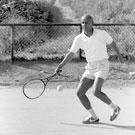
On March 3rd 1979, Sri Chinmoy completed his first marathon in Chico California in a time of 4:31:34. Each year since then, his students in New York and around the world have honoured him by running the 26-mile distance.

Video by Utpal Marshall
On March 3rd 1979, Sri Chinmoy completed his first marathon in Chico California in a time of 4:31:34. Each year since then, his students in New York and around the world have honoured him by running the 26-mile distance.
Sri Chinmoy is interviewed on WRVR’s ‘Connections’ programme in Connecticut, USA.
Sri Chinmoy delivers a lecture, entitled ‘Experience’, in the Commons Room, Graduate School, at Princeton University, Princeton, NJ, USA.
Sri Chinmoy delivers an evening lecture (8 p.m.), entitled ‘The Heart’, in David Rittenhouse Auditorium, University of Pennsylvania in Philadelphia, PA, USA.
Sri Chinmoy writes 7 more Indian stories (81-87), which are later published in Great Indian Meals: Divinely Delicious and Supremely Nourishing, part 5.
Sri Chinmoy runs the Orange Bowl Marathon in a time of 5:33:33, in Miami, FL, USA.
Loro Parque is inaugurated as a Sri Chinmoy Peace Park, in Puerto de la Cruz, Tenerife, Canary Islands, Spain. Sri Chinmoy presents the park with a commemorative award bearing his ‘Soul-Bird’ drawings. After the inauguration, Sri Chinmoy answers a series of wide-ranging questions.
The world’s first Sri Chinmoy Peace Airport is inaugurated at Reina Sofia International Airport in Tenerife, Canary Islands. Spain.
Sri Chinmoy meets with Dr Hubert Reynolds, Professor of Peace Studies at Silliman University, at the South Seas Resort Hotel in Dumaguete, Negros Oriental, Philippines.
Sri Chinmoy attends the inauguration of Faleolo International Airport as a Sri Chinmoy Peace Airport in Apia, Western Samoa. Representing the Western Samoa Airport Authority at the ceremony is the airport manager Etuale Sefo.
Sri Chinmoy offers a Peace Concert (402) — the 2nd of 50 concerts held in honour of the 50th anniversary of the United Nations — at the Maui Lu Hotel in Kihei, Maui, Hawaii, USA.
Sri Chinmoy participates in the Runners are Smilers 2-mile race in Asunción, Paraguay. His time is 39:49.
Sri Chinmoy gives a talk to his students, entitled ‘Only Friend, Best Friends, Fair-weather Friends’, at the Rex Hotel, Ho Chi Minh City, Viet Nam.
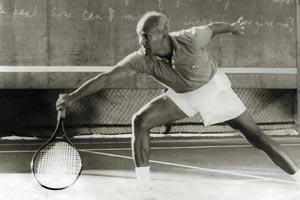
Sri Chinmoy speaks about his days as a champion athlete in the Sri Aurobindo Ashram, in Poficherry, India, during an afternoon function with his students in Xi’an, China.
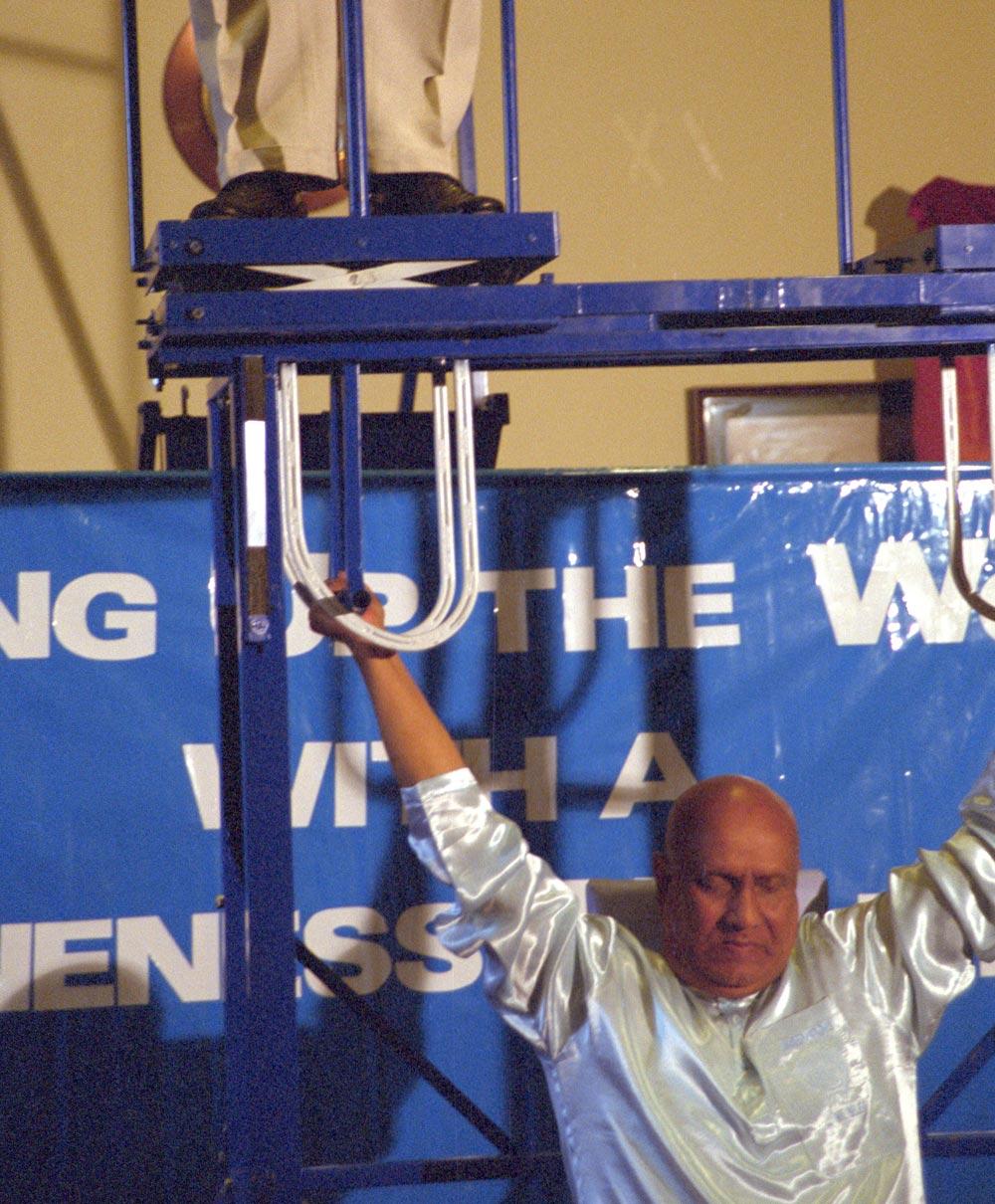
Sri Chinmoy lifts 41 orphans from Tengku Ampuan Fatimah Orphanage, at the Awana Kijal Golf Resort in Terengganu, Kuantan, Malaysia.
APIA, Western Samoa — The Faleolo International Airport was dedicated to the cause of world peace Jan. 22 in honour of visiting good will ambassador Sri Chinmoy.
“The Ambassador of Peace brings to Samoa a project and a peace message which is already enshrined in our culture,” said Airport Manager Etuale Sefo, representing the Western Samoa Airport Authority. “The most fitting reminder of this message is our dedication today as a Sri Chinmoy Peace Airport.”
Sri Chinmoy, who was passing through Apia enroute to New York, said: “We are not strangers. You have accepted us as your true brothers and sisters. That is why you are so affectionate, compassionate and loving to us in every way.
“We now find ourselves in a boat, which is known as the Peace-Boat, and we see around us thousands and thousands of peace-dreamers and peace-lovers. We are sailing together toward the destined Goal that is inundated with peace.”
Western Samoa’s airport joins nearly a thousand other sites around the world that have been dedicated to peace in Sri Chinmoy’s name.
Published in Anahata Nada, VOLUME 23, MID-DECEMBER 1993-MARCH 1994
Video by kedarvideo
Sri Chinmoy offers a Peace Concert dedicated to the 50th Anniversary of the United Nations, in Maui Lu Hotel, Kihei, Maui, Hawaii.
by Sri Chinmoy
at the Maui Lu Hotel, Kihei, Maui, Hawaii
Today’s Peace Concert I am most prayerfully and most soulfully dedicating to the world-oneness-peace-dreamer-soul of the United Nations, which is marking its fiftieth fruitful year.
Published in My Prayerful Salutations to the United Nations
Sri Chinmoy participates in the Runners are Smilers 2-mile race in Asunción, Paraguay. His time is 39:49.
Sri Chinmoy’s race prayer:
My Lord, my Lord, my Lord!
My God-discovery has solved
Not only all intricate mysteries,
But also all insoluble problems,
Past, present and future.
My Lord, You have given me
And I have.“My child, I have given you
And you are.”
Published in My Race-Prayers, part 1.
Sri Chinmoy reminisces
about his days as a champion athlete in the Sri Aurobindo Ashram, during an afternoon function in Xi'an, China
My brother Mantu was so fond of my athletics. At the competition time, he used to get all the anxieties and worries on my behalf. And whenever I won the race, his chest used to become so much larger! When I was participating, he was so one-pointed for me to become first in everything. Then the funniest thing happened. We had quite a few harmoniums. One year somebody happened to score more than I did in the decathlon event. So Mantu gave my harmonium to him. Mantu said he deserved it because he was a good singer and he did not have a harmonium. So he gave away my harmonium. The same brother, can you imagine!
Over the years, my disciples have given me many pairs of running shoes. Ongkar has given many, Unnatishil has given many. But it was too late. They should have given me shoes while I was in India. At that time I needed shoes desperately. When I was a champion runner, I had to run barefoot, barefoot, barefoot. Poor me, I did not have shoes. Here is the proof that my hour and God's Hour do not have to be the same.
But when I became the decathlon champion for the second time, I got a gold medallion plus a pair of shoes. Alas, the shoes were too big for me. They did not fit. Bad luck!
For 16 years uninterrupted, I stood first in sprinting. Long jump I won many, many times. Shot put also I won for 14 or 15 years and 400 metres for about 14 years. In javelin I was quite good.
Of all the items, my worst was 1500 metres. I used to practise once a year from the day of the competition until the day of the next competition. Why? Because we had a wonderful theory that if you practise long distance running, your 100-metre sprint will suffer; you will not be able to run on your toes. It was such a stupid idea! Up to 400 metres I practised, but 1500 metres only once per year. In other distances — 3,000m, 5,000m — I was worse than the worst.
The Mother could not believe how bad I was at those distances. She said, "How is it that in 100 metres he is the fastest, but in long distance he is so bad?"
Her attendant said, "Mother, these are two different things. Usually, sprinters cannot do middle distance or long distance." It is so true!
There were some other sprinters in my boat. When we completed one round in those long races, some other runners had completed three rounds! After one round, we used to get thunderous applause. We thought that the audience was clapping for us because we were running so badly. Who knows whether they were clapping for us or for those who were defeating us by so much? But we sincerely felt they were clapping for us.
In the decathlon, my worst event was the 1500 metres. But in all the other events I did very well.
Published in The Inner Meaning of Sport
Reina Sofia International Airport in Tenerife, Canary Islands, is named the world’s first Sri Chinmoy Peace Airport. The 60-foot-long sign at the entranceway displays the words in Spanish: ‘El Primero en el Mundo Aeropuerto de la Paz Sri Chinmoy’.
Angel Gallego, Airport Director:
Sri Chinmoy is an extraordinary man whose works for peace are spreading throughout the world.
Sri Chinmoy:
When we have something that is dedicated to the cause of peace, it is very significant in our life. The word ‘peace’ is very, very important in our life. You can say it is the most important thing in our life.
Everything else we have in today’s world, but we do not have peace.
If we want name and fame, prosperity and so forth, we can get them. But when it comes to peace, we do not easily get it.
Peace is a most difficult thing to attain. But when there is a monument that mentions peace and people come and see it, they try to have peace in their own lives.
by Sri Chinmoy
while in residence at the Sri Aurobindo Ashram in Pondicherry, India
I asked Amrita-da: "Please tell me in what language the Mother used to speak with Sri Aurobindo?"
He said: "It was always in English."
"And in what language did you speak to Sri Aurobindo?"
"I spoke almost always in English, only at times in Bengali."
"And what about the Mother? What language did you use to speak to Her?"
He said: "Ah, that you know: English, French and what-not."
Published in A Service-Flame and a Service-Sun
A lecture by Sri Chinmoy
at the David Rittenhouse Auditorium, University of Pennsylvania, Philadelphia
Dear seekers of the transcendental Truth, dear sisters and brothers of the one transcendental Spirit, this evening I wish to give a talk on the heart.
I wish to tell all my friends and my spiritual brothers and sisters here in Philadelphia that inside the heart of each individual seeker rings the Liberty Bell. The Liberty Bell that we see here in Philadelphia has a large crack, and therefore it does not ring properly. But in the inner life, our Liberty Bell rings perfectly. It is up to each individual to listen to his inner bell every day. This bell has been ringing from time immemorial in each individual soul, inspiring the soul to take part in God's cosmic Drama and to run fast, faster, fastest towards the destined Goal.
We have a loving heart, an aspiring heart, an inspiring heart, an illumining heart and a fulfilling heart. With our loving heart we welcome the world at large. With our aspiring heart we climb up to the highest pinnacle of divinity. With our inspiring heart we inspire not only the world within us, but also the world without — the world of God's entire creation. With our illumining heart we illumine our ignorance, darkness, imperfection and bondage. With our fulfilling heart we fulfil God the Dreamer in us, God the Player in us, God the Lover in us and God the Beloved Supreme in us.
Also, with our loving heart we can unconditionally surrender ourselves to the Will of God. With our aspiring heart we can grow into the very image of God. With our inspiring heart we can spread the message of God throughout the length and breadth of the world. With our illumining heart we can manifest our inner divinity on the outer plane. And with our fulfilling heart we can fulfil both God the Creator and God the creation at once. Our fulfilling heart is nothing other than our unconditionally surrendered heart flying with the wings of the Supreme.
When we enter into the spiritual life, we come to realise that we also have a soulful heart, a heart of peace and a heart of delight. The soulful heart we need at every moment in our life of aspiration. Without it we cannot make an iota of inner progress. The peaceful heart we need because when peace is wanting in our life, this life has no abiding satisfaction. The heart of delight we need because it is the very source of our divine plenitude and infinitude. We came from delight, we live in delight and, at the end of our journey's close, into delight we retire.
Anandadd hy eva khalv imani bhutani jayante...
How can a beginner in the spiritual life have a soulful heart? Let him look into the sky in the evening when the sun starts to set. When the beginner-seeker looks at the sky and becomes deeply absorbed in the setting sun, his soulful heart comes to the fore. If the beginner needs a peaceful heart, let him concentrate, meditate and contemplate on the very depths of the ocean, the ocean of life. And if he needs a heart of delight, let him look at the ocean surface and allow his inner being to get in tune with the waves of the ocean.
The heart is most intimate to us and most significant in our life. When our physical heart fails, we pass behind the curtain of Eternity and die. Similarly, in the spiritual life, when our heart of aspiration fails even while we are living here on earth, we will be living in the world of death. Medical science will tell us that the physical heart is located within the chest on the left side. Some spiritual Masters are of the opinion that the spiritual heart is on the right side, and others are of the opinion that it is in the middle. Then again, there are still others who are of the opinion that it is inside the forehead, a little above the eyebrows. Naturally these spiritual Masters are dealing with the spiritual heart, and each is right in his own way. Each has discovered the heart according to his own inner light and inner wisdom.
When we are told that the heart is between and a little above the eyebrows, at the outset we are bound to be puzzled and somewhat disturbed. Whether it is on the left side or the right side of the chest may be immaterial to us. But when we are told that the heart is located between the eyebrows, naturally we are thrown into a sea of confusion. But I wish to say that those who are of the opinion that the heart is located there are perfectly right in their way, for that place is the source of our intuition, of our intuitive light. Heart means light. Wherever we feel the presence of light, without the least possible hesitation we can say that that very place is the heart, heart and light are one and the same thing.
Now we have to know that the heart is not the highest or the most perfect member of our inner family. It is the soul that is the highest, because the soul is all light. In the soul there is no darkness at all. The human heart receives light from the soul, and that is why the soul is superior. It is the source of the heart's light. The human heart identifies with the soul's light, whereas the mind finds it extremely difficult to do this. That is why the heart is superior to the mind. Again, the mind is superior to the vital because the mind searches for the truth, for light — at times consciously, at times unconsciously. But the vital does not care for the highest truth. The vital cares for the truth only when the truth offers satisfaction in the vital's own undivine way. But the vital does at least care for light, whereas the gross physical does not want light at all. It is ready to remain imperfect and incomplete for millennia.
When we enter into the spiritual life, we discover that there are two significant roads that can lead us towards our destined Goal. One road is the mental road, the road of the mind; the other is the psychic road, the road of the heart. Now both of these roads will take us to our destined Goal. But one road is shorter and safer, and that is the road of the heart. When we follow the road of the mind, at any moment doubt can snatch us away. The world's information can pull down human aspiration. But the road of the heart is sunlit. When he follows this road, a seeker always feels deep within himself a deer running towards the destined Goal. Each individual has to know whether he listens more to his mind or more to his heart. The message of the heart is altogether different from the message of the mind. Since we want to reach our Goal as soon as possible, we feel the supreme necessity of the heart.
There are two ways of approaching the ultimate Reality: one is the way of knowledge and the other is the way of love. Those who follow the path of the heart become convinced, on their way to self-discovery, that love itself is the supreme Knowledge. Right now, knowledge and love seem like two different things. The mind supplies us with knowledge and the heart supplies us with love. But the deeper we go, the clearer it becomes to us that love and knowledge are one and the same. God is omniscient, God is omnipotent, God is omnipresent. He is everything. He embodies Infinity, Eternity and Immortality. But when we go deep within, we find that these qualities do not satisfy us. There is only one aspect of God that satisfies us totally and most convincingly, and that aspect is God's Love. When on the strength of our own love we approach God's infinite Love, we are totally satisfied. We will not be satisfied when we see or feel God the all-awesome. Only the Love aspect of God quenches our eternal thirst.
In the spiritual life we see that two hearts can and often do become inseparably one with each other. One is the heart of the seeker or disciple, and the other is the heart of the teacher, the spiritual Master. These two hearts are constantly singing one song, the song of self-giving. When a true disciple meets his Master for the first time, his inner and outer promise to the Master is this: "I want nothing from you. Although I have come to you so that you can help me in my God-realisation, even if you never grant me God-realisation, my love for you, my devotion to you and my oneness with you will always remain total and unconditional." So a real seeker uses his heart of oneness, his heart of self-giving, when he accepts his Master. And he will grow into spiritual perfection through his love and devotion for the Highest in his Master, the Inner Pilot, God the Supreme. The spiritual Master also uses his heart when he accepts a disciple who comes to him for inner guidance. On the strength of his own self-giving heart, the Master tells his disciple, "I have already accepted you, no matter what you do for God. Even if you do not do anything for God, for God's manifestation, still I shall go on loving you."
So the disciple's heart becomes one with the Master's heart and makes the solemn promise: "Whether or not you help me in my God-realisation is up to you, but I shall go on loving the Supreme in you forever." And the Master also makes a solemn, soulful promise to the disciple: "Whether you care for God-manifestation or not is up to you, but my love for you and my self-offering to you shall remain unconditional forever."
It is said that a pure heart is everything. Now what does it mean to have a pure heart? First of all, there must be sanctity and serenity in the heart. But I wish to say that that is not actually enough. A pure heart means a heart that embodies the constantly climbing flame of aspiration. If within the heart there is an ever-mounting flame that wants to reach the Highest, then that is the heart of purity. All of us here have a pure heart to some degree. Since we are all seekers here, we are bound to have the inner flame of aspiration in our heart. Let us try to feed this inner flame through our constant spiritual practice, through our daily prayer, meditation and contemplation. The highest transcendental Goal resides deep within each of us. Our Goal can never be a far cry; it is within our reach, provided we constantly look ahead, look deep within and look upward to the highest Height.
We leave the starting point the moment we feel in the inmost recesses of our heart the flame of aspiration. Once we have left the starting point, it is only a matter of time before we reach the Goal. Those who are awakened can run the fastest towards the destined Goal. Those who are in the process of awakening may rest assured that the Goal is awaiting them. And those who still cannot get up will not be belittled by those who are in the process of awakening or by those who are already awakened. The spiritual life is not a life of competition. If competition is at all necessary, then each should compete with his own weaknesses, imperfections and limitations, with his own bondage and death.
If we practise meditation regularly, faithfully and devotedly, not only do we come closer to our Goal, but the Goal itself comes running towards us. Halfway along the path, the Goal and the runner meet to fulfil each other's needs. By reaching the Goal, the runner fulfils his task, the task of realising the highest possible Truth. And by reaching the runner, the Goal makes the manifestation of the highest Truth not only possible and practicable but also inevitable. The Goal and the runner fulfil themselves as they fulfil their respective roles in the life of aspiration and in the life of manifestation.
Published in Fifty Freedom-Boats to one Golden Shore, part 1
by Sri Chinmoy
The Governor-General of India was an Englishman named Lord Bentinck. He was very strict and everybody was frightened to death at the very mention of his name.
Raj Rammohun Ray at this time was very well known as a man of knowledge and a great patriot. He was also a linguist who knew many languages.
One day, the Governor-General sent a messenger to Rammohun with the message: “The Governor-General wants to see you immediately.”
Rammohun said to the messenger: “I know he is the Governor-General of India, but that does not mean that I have to listen to him and come immediately.”
The messenger was shocked. “What do you mean?” he said.
“I will come if I have to, but in my own time,” said Rammohun.
“I cannot believe this,” said the messenger. “Even in my dreams I would not be able to believe this kind of thing. You Indians are at our feet, and yet you are acting so proud and haughty. You will see what kind of punishment you will get from Lord Bentinck.”
Rammohun only said, “I am fully prepared. I know what kind of punishment I shall get, but also I know what I have to do with a foreign boss.”
On hearing the story, Lord Bentinck became furious. But he said to himself, “By becoming furious, what am I going to accomplish. I need some help from Raj Rammohun Ray, so let me be wise. Since I am the needy one, I have to be very careful.”
He wrote a very polite letter to Rammohun: “I am ready to see you at any time that is convenient for you. I will send my car to bring you here. Please let me know when you can come. I will be extremely happy and honoured to receive you.”
The messenger came with the letter, and as soon as Rammohun read it, he said, “I am ready to see the Governor-General.”
Rammohun explained to Bentinck when he saw him, “My skin may be dark, but I do have my own sense of prestige. You asked for me to come to see you immediately, but I did not come because my pride and prestige were hurt. When you wrote me a polite letter, then I felt sympathy for you. You may feel that the Indians are inferior, but you cannot treat us in that way.”
The Governor-General shook hands with Rammohun and agreed, “I know it is absolutely necessary to preserve one’s prestige. It was wrong on my part to address you in that way.”
Rammohun said, “Your nobility has touched the very depths of my heart.”
Wherever Rammohun went, he played the role of a leader most successfully. Everybody admired and adored him. The great poet Tagore wrote of him, “He is the traveller of India.”
Indeed, Rammohun was the traveller who spread India’s love-message, wisdom-message and oneness-message all over the world.
Surya Sen was a great patriot, a great revolutionary and a great martyr. Far beyond human imagination were the number of hours he worked to liberate his Mother India. The people of Chittagong adored this great hero. His very name used to give them tremendous joy, tremendous inspiration, tremendous encouragement and a tremendous sense of fulfilment. They called him Master-da. Master means teacher; da is the elder brother. He was everybody’s elder brother; even people who weren’t much younger than he called him Master-da.
He was a teacher. To him belonged the duty of transforming the British schools into Indian national schools. He used to teach in one of these national schools, and he conquered his students’ hearts with his affection, love and concern.
He was not rich, nor handsome, nor striking in any way, but his inner strength was indomitable. His eyes used to shine brighter than the brightest. His inner personality conquered everybody’s heart. Bande Mataram — “Mother, I bow to Thee” — was his sole mantra.
On February 18, 1930, the revolutionaries of Chittagong, led by Surya Sen, broke into the British armoury and stole a large quantity of guns and ammunition. Chittagong was thrown into the vortex of revolution. Previously, the military used to torture any revolutionaries whom they caught. Torture is an understatement! But after the armoury was robbed, the British Government resolved to put an end to their problems by capturing Surya Sen. So they offered a 10,000-rupee reward to anyone who could tell them about Surya Sen. Whether he was brought to them alive or dead, the British Government would pay 10,000 rupees.
But who among the people would do this kind of thing? Everybody loved Surya Sen dearly and adored him highly. But alas, God’s creation is very peculiar. One of Surya Sen’s relatives became jealous of this great hero and reached the height of meanness and treachery. His name was Netra Sen.
Surya Sen was always in hiding, moving from one place to another. Sometimes he used to take a job as a workman; sometimes he would take a job as a farmer, or milkman, or priest, or houseworker. This is how he used to avoid being captured.
Either because of money, or out of jealousy, or because of both, Netra Sen told the British Government that Surya Sen was at his house. As a result, the police came and captured him. This is how India’s supreme hero was arrested. But before Netra Sen was able to get his 10,000-rupee reward, he was sent to God.
This is how it happened. Netra Sen’s wife was all for Surya Sen, and she was horrified by her husband’s deed. She felt mortified by her husband’s betrayal of Surya Sen. She couldn’t believe her eyes; she couldn’t believe her ears.
One evening she was serving her husband food when a great admirer of Surya Sen came into the house. He was carrying a very big knife, which is called a dal. With one stroke of the dal he chopped off the head of Netra Sen in the presence of his wife. Then slowly and stealthily he went away.
When the police arrived to investigate, they asked Netra Sen’s wife if she had seen who the murderer was. She said, “I saw with my own eyes, but my heart will not permit me to tell you his name. I am sorry. I feel miserable that I was the wife of such a treacherous man, such an undivine man as Netra Sen. My husband betrayed the greatest hero of Chittagong. My husband betrayed a great son of Mother India. My husband cast a slur on the face of India. Therefore, I cannot tell the name of the person who took his life. He has definitely done the right thing.
“You can do anything with me. You can punish me, you can even kill me, but I shall never tell the name of the person who killed my husband. Our Master-da will be hanged, I know, but his name will forever be synonymous with India’s immortal freedom-cry. Everybody loves him. Everybody adores him. I, too, love him and adore him, for he is the brightest sun in the firmament of Chittagong. Surya means sun and he is truly our sun.”
On 12 January 1934, before the sun rose, Chittagong’s sun, India’s sun, was hanged. Before he was hanged, this great lover of India, this supreme lover of India, uttered his heart’s mantra once: Bande Mataram — “Mother, I bow to Thee”.
In 1905 Bengal was divided in two by Lord Curzon. Bengal’s great political leaders were dead against it, but they were helpless. So there was a great revolt in Bengal. The political leaders and the adorers of Mother India were all fighting against the British. But the British were ruthless. Whenever they heard people chanting Bande Mataram, they used to arrest them. For the Indian patriots, Bande Mataram was the slogan. Bande Mataram was their mantra; Bande Mataram was their life-breath. By uttering Bande Mataram, thousands and thousands of people embraced death.
Of all the English, Judge Kingsford was the worst. He used to torture the revolutionaries mercilessly; his activities were atrocious. This led the revolutionaries to decide that Kingsford must be killed.
Two young men, two great revolutionaries, were chosen to execute this task. One was Peraphulla Chaki, the other was Khudhiram. They were young, they were spirited, they were devoted and they were sincere. They were two jewels of Mother Bengal. Their leaders were all appreciation for them and their friends were all admiration for them. So they took up the challenge; they would kill Kingsford.
Every evening, it was Kingsford’s custom to go out in his carriage for a short ride. One evening, they hid near Kingsford’s bungalow and when the carriage pulled away from the bungalow, the two young men attacked it. They threw a bomb into the vehicle and completely destroyed it. Alas, on that particular day Kingsford was not inside. Instead, his friend, Mrs. Kennedy, and her daughter were in the carriage, and both of them were killed.
Peraphulla Chaki was arrested but Khudhiram somehow managed to escape. Before the British Government could punish Peraphulla Chaki, this hero of heroes committed suicide. In a few days’ time Khudhiram was also arrested. He was caught in a railway station.
There was only one way in which the British Government dealt with such cases: on 11 August 1908, Khudhiram was hanged. But before he was hanged he sang a particular line from a song with all his heart’s soulfulness:
“Mother, farewell! I am going out just for a short while. Mother, farewell! Do give me the permission to go out and come back.”
This particular line he sang a few times, and then he was hanged.
Yes, Khudhiram did come back to Mother Bengal. He came back in different bodies, in different names, in different shapes — with new determination, new boldness and a heart of supreme sacrifice from Heaven.
Swami Vivekananda’s earlier name was Narendranath and his nickname was Bile. During his childhood and even in his adolescent years, he was extremely mischievous. This did not diminish his divinity. But his parents, especially his mother, sometimes would get puzzled and worry about him.
She used to say, “O Lord Shiva, I prayed to you to grant me a son like you. But instead of coming into my life, you have sent me your ghost. He is nothing but a ghost, my Bile, always breaking things and creating problems for me. How long can I tolerate his endless mischief?”
But there were quite a few good qualities that his mother also saw in him, so inwardly she was satisfied. But outwardly she always told everyone, “My Bile is so notorious!”
One day, when he was only five years old, Vivekananda saw in the living room a few Indian hookahs or smoking pipes. One was for the Brahmins, one for the Kshatriyas and one for the Muslims. He tasted each one, and to his surprise discovered that all the hookahs tasted the same.
Alas, he was caught by his own father. “What are you doing, Bile?” he asked.
Vivekananda replied, “Father, I was just examining the smoking pipes. I thought that the one for Brahmins would be better than the one for Kshatriyas, because Brahmins are so great. And the Muslims are so heroic and spirited, so I thought that the Muslim pipe would be special. But they are all the same. I wish to tell you, Father, that they are all the same. No one pipe is superior to another.”
Vivekananda’s parents were simply shocked. “How is it that you have started smoking at such a tender age?” they asked. “And what kind of things is a small boy like you saying?”
Then his mother said, “My son, you are too spoiled. You have become too smart. Come here.” The child came to the mother and she took him upstairs to his room and closed the door from outside.
In two hours’ time the maid came running to the mother, screaming: “Bile is throwing away all his clothes. Everything he has in his room he is throwing out through the window! There are a few beggars below who are grabbing his garments as they fall. And he himself is so happy!”
At this the mother ran upstairs and demanded, “What is the matter with you, Bile? Such expensive clothes you are throwing away!”
Vivekananda replied, “Mother, we are so rich. We can have whatever we want, whenever we want. But these are poor people. They have nothing, nothing. If we do not give to them, then who will give to them? We have enough, more than enough; so my heart wants to give these things away. They need them more than I do.”
His mother’s heart was full of joy and delight. She embraced her son and shed tears of delight that his heart was so sympathetic, so vast and so all-giving, and that he had so much oneness with the poor and with the Supreme Pilot in all.
Swami Vivekananda enjoyed smoking. In the days of his pilgrimage, when he used to walk along the streets of India, here, there and elsewhere, smoking was his great avocation.
One evening, as Vivekananda was walking along a village street in northern India, he came to a small cottage where an old man was smoking an Indian hookah. Vivekananda had a tremendous desire to smoke, and he asked the old man if he would give him his pipe.
The man said, “Oh, Swami, I am a scavenger, I am an untouchable. How can I give you my hookah? How will you smoke from the hookah of an untouchable? I am so happy to see you. You are so handsome, so spirited. I am so fortunate to see you. But, alas, I come from an untouchable family.”
Vivekananda felt sorry that the old man was an untouchable. He said to him, “I am sorry, I am sorry. Alas, I won’t be able to smoke.” Vivekananda left him and continued walking.
In a few minutes he felt miserable. He said to himself, “What am I doing? What am I doing? What have I done? What have I done? Did not Thakur teach me that wherever there is a human being, there also is Lord Shiva? Each human being embodies God. This is what I have learned from my Master, Sri Ramakrishna.
“I have given up everything; I am a sannyasin. So I am one with the rest of the world by virtue of my renunciation. Yet although I have renounced everything, still I have preserved this sense of discrimination. Here is a cobbler, here is a scavenger, here is a Brahmin, here is a Shudra. Low caste, high caste! How can I have the heart to distinguish? Are they not all God’s children? The sense of separativity, the sense of superiority and inferiority: How can I have that kind of feeling?”
Vivekananda then went running back to the old man and said, “Please, please, give me your hookah. Each man is God Himself.”
The old man fearfully and, at the same time, happily gave the hookah to Swami Vivekananda. Swami Vivekananda smoked to his heart’s content and then said to the old man, “I am divinely happy, supremely happy, for two reasons. My human desire is fulfilled; I am able to smoke. And my divine desire is fulfilled, because I have been able to realise my inner vision of universal oneness. My Supreme Lord abides in all. This vision of mine I have been able to manifest today by smoking here from your hookah at your house.
“God is for all. He is not only for me, but He is for all. In each individual Him to see, Him to please unconditionally, is my only goal. I shall remain ever grateful to you, for it is through you that my Lord has taught me the supreme lesson: that we are all one, we are all equal, we are all children of our Absolute Lord Supreme.”
Vidyasagar was the ocean of knowledge and also the ocean of compassion. There were people who used to think of him early in the morning and pray to God to make them as kind and as great as Vidyasagar. He was loved by everyone and adored by everyone.
Vidyasagar was one of those who helped to elevate the consciousness of the Bengalis tremendously, and in hundreds of ways he served the people of Bengal. He helped the Bengalis infinitely more than anyone can imagine in social activities and in fighting for the education of women and the early remarriage of widows. He also helped the poor and the needy, not only unreservedly, but also unconditionally.
Once he went to a particular district that was not well-known and where the people were not well-educated. He happened to be sitting at a railway station, watching the trains coming and going. In a short while a particular train stopped and a few passengers began to step down from it.
It was a very small railway station and there were very few coolies, so the passengers had to carry their own luggage. One young man began shouting, “Coolie! Coolie! Coolie!” He had only a small briefcase, but he was shouting for a coolie and nobody was there to come.
Vidyasagar stood up and went over to the young man. “I will carry it,” he said. The young man did not know that Vidyasagar was a great man. He always wore the most modest clothes. And perhaps the young man had never even heard of Vidyasagar. God knows. Anyway, Vidyasagar took his briefcase and pretended to be a coolie because he was so modest and humble.
Carrying the briefcase, Vidyasagar followed the gentleman to the house of his parents-in-law. It was to be their first meeting since he had married their daughter. Vidyasagar and the young man arrived at their house and the hosts came out to greet them. Although they were simply delighted to see their new son-in-law, they were shocked to death to see Vidyasagar carrying his briefcase.
They fell at Vidyasagar’s feet and said, “How can you do this? How can you do this? Will God not curse us? In knowledge, in compassion and in love, you are the greatest man in Bengal, and yet you carry this briefcase for our son-in-law! He is such a stupid fellow. He did not know who you are. Even now there is no remorse on his part!”
All the members of the household were so shocked, and they begged Vidyasagar to forgive the young man. Gradually, gradually, the son-in-law began to realise what he had unconsciously done.
Then Vidyasagar said to him, “It is because of you that Bengal is not progressing. You will never do your duty. It is such a tiny briefcase, and so light, but still you cannot carry it yourself. You have to wait for a coolie. Yes, when it is heavy, I understand; but when it is something that you can do yourself, that is incomprehensible to me. I am desperately trying to encourage people to be active, dynamic and self-sufficient. It is because people like you don’t do your duty, which is so easy to do, that today Mother Bengal is so inferior to other parts of the world. You are all a disgrace to our country.”
In this way Vidyasagar scolded them. The members of the family gladly accepted his scolding. “We deserve it. We deserve it. But we are very glad and grateful that you have come to our house. We could not have brought you to our house otherwise.”
Vidyasagar replied, “No, you are wrong. I go to everybody’s house. You people have made me great. You people have made me good. But I want everybody to be great and good. Then only my sister and brother Bengalis will really make progress. If you are not self-sufficient, if you are not active, if you are not dynamic, then you can never become good instruments for God and good instruments to achieve something great for Mother Bengal.”
At this point the young man also fell at Vidyasagar’s feet and said, “Vidyasagar, in addition to being the ocean of knowledge, you are also the ocean of compassion. Forgive me. From now on I will be a totally different person.”
Vidyasagar blessed him, saying, “I need young people like you who will really work very hard, who will offer their heart and soul to raise the standard of Mother Bengal. I offer you my blessings unreservedly.
There was once a Muslim king who had a most beautiful daughter. Unfortunately or fortunately, his daughter had tremendous admiration for a Hindu king. This Hindu king was unmarried and the Muslim king’s daughter wanted to marry him. But the Muslim king said, “Impossible! I will not allow you to marry a Hindu!”
The Muslim princess protested in the strongest terms. She said, “No, you have to allow me to marry him, because love is love. I admire him and love him. I must have him.”
What could the Muslim king do? His daughter’s happiness was dear to his heart. So he sent a messenger to the Hindu king seeking his views on the matter. As it happened, the Hindu king also loved this Muslim princess. So he replied, “If she loves me and I love her, then I don’t see why we can’t get married.”
In due time, the two were married. The Muslim king tolerated the fact, whereas the parents of the Hindu King were very agreeable to the union. They said, “To please you, son, is our only desire.” As this old couple had advanced in years, they had made their son the king and now, in their support of his marriage, they once more showed their tremendous love for him.
Over the years the Muslim king became terribly jealous of his son-in-law. Everybody appreciated and admired the Hindu king because of his courage, wisdom and sense of charity. Even the Muslim king’s own subjects had tremendous appreciation for the Hindu king. The Muslim king could not tolerate this. He wanted to conquer his son-in-law’s kingdom, especially the capital, and throw his son-in-law in jail.
So, quite unexpectedly, he and his army attacked the Hindu king’s palace. There was a terrible fight, but after a few days the palace was captured and the Hindu king was arrested. The Muslim king brought him to his palace and would not allow him to go back to his kingdom. He said, “You have to stay here in exile. Only on one condition shall I allow you to go back: if you send my daughter back to me and say that she is no longer your wife.”
The Hindu king said, “I love your daughter; your daughter loves me. Our love for each other is tremendous. What will she think of me if I do this?”
The Muslim king said, “If you won’t divorce my daughter, then I shall kill you.”
What could the Hindu king do? He was helpless.
The wife of the Hindu king was furious that her father had attacked her husband without any advance warning. She put on her husband’s uniform and started fighting against the Muslim king’s army. Some of the soldiers laughed at her because she was so weak, although she was determined to fight and kill them. Some ran away out of fear that while defending themselves from her blows they might kill her, and they were extremely fond of her. Only a few completely took their king’s side. “If you come near us,” they said, “we will kill you.”
In the meantime, a messenger came to the Hindu queen with a letter from her captured husband. When she read the message, she could not believe her eyes: “If I don’t divorce you, your father will kill me. Therefore, I am divorcing you and returning you to your father. You go back to your father and let me come back to my kingdom. All I want to do is rule there peacefully.”
The wife cried out, “Is this a Hindu heart? I loved a Hindu heart and against my father’s will I married this man. I gave my all to him, I sacrificed everything for him. Now he has divorced me. And I am fighting to bring him back! I love my husband so dearly, but he loves his kingdom more than he loves me. His kingdom is more precious to him than my life’s own sacrifice.”
The wife grabbed a dagger. “You will get your kingdom back, but my father will not get his daughter back!” she said, and then she killed herself.
In a few days the Hindu king returned. At first he shed sincere tears over the loss of his wife, but then he became involved in ruling his kingdom peacefully and he began to forget her.
The Muslim king was struck with grief for what he had done. Instead of getting back his daughter, he lost her for good. The Muslim queen became mad at her husband and she said, “You should be hanged! Because of you we lost our dearest daughter. She loved her husband and he loved her. Is not love more important, infinitely more important, than your religion? Who is Hindu, who is Muslim? The dear ones will always remain dear. There is no Hindu, there is no Muslim; there is only oneness. Because of your stupidity, today I have lost my dearest daughter. Had I been in your place, I would have destroyed my life.”
The Muslim king said, “Stop your philosophy! If I die, it is you who will be the sufferer. Already you have lost your daughter, and now you want to lose your husband as well? You will not be able to bear your suffering!”
The queen said, “No, I will be able to bear my suffering because I love justice. Because of you, I have lost my dearest daughter. If you die, I will feel that this is real justice.”
The king said, “You may love justice, but I also have some sense of justice with regard to my subjects. If I die, they will be fatherless. I have made one serious blunder. So what? If I stay on earth I can still do many good things for my subjects. I want to stay on earth.”
“Yes, stay on earth,” the queen cried, “and I shall also stay on earth with a broken heart. But the whole world will hate you, and I will be the one to hate you most. I will stay on earth, not because I am needed, but in order to treasure the memory of my dearest, sweetest daughter. If I die, I do not know what will happen or where I will go, but if I stay on earth I will be able to repent. And my repentance is my consolation, my repentance is my illumination. For that purpose I will stay, whereas you can stay to lead a shameless life!”
Published in Great Indian Meals: Divinely Delicious and Supremely Nourishing, part 5
questions at the Loro Parque National Bird Park in Tenerife, Canary Islands, after it had just been inaugurated as a Sri Chinmoy Peace-Blossom
Sri Chinmoy: This island is not only beautiful, but also self-giving. There are many islands that are very, very beautiful, but they are not self-giving, and they are not peaceful. This island is both beautiful and peaceful. This is something rare and unique.
Question: What is the purpose of the monuments that we have inaugurated?
Sri Chinmoy: The purpose is very simple. When we have something that is dedicated to the cause of peace, it is very significant in our life. The word ‘peace’ is very, very important in our life. You can say it is the most important thing in our life. Everything else we have in today’s world, but we do not have peace. If we want name and fame, prosperity and so forth, we can get them. But when it comes to peace, we do not easily get it. Peace is a most difficult thing to attain. But when there is a monument that mentions peace and people come and see it, they try to have peace in their own lives.
When we look at a flower, we try to be as beautiful and soulful as the flower. We want to be full of fragrance inside our heart. Similarly, the word ‘peace’ on these plaques and monuments reminds us of our inner peace.
I wish to offer love, joy and gratitude from the very depths of my heart to the owners of this bird park. They have been so kind to me. Each bird, according to me, symbolises the soul. The soul comes down from the highest Heaven and gives us the message of freedom, infinite freedom.
We believe in God, and we feel that each human being has a direct connection with God through the soul. A bird reminds us of our own inner existence. Again, we believe in the process of evolution. I take each bird, each animal, as our predecessor. They are our forebears; you can say they are our great-grandparents. It is our bounden duty to take care of our great-grandparents.
Question: What is your opinion about the pollution of the environment?
Sri Chinmoy: It is a very sad thing that nature is being destroyed, the environment is being destroyed. It is nature that keeps us beautiful and soulful. When nature is destroyed, when artificial things replace the natural beauty, all the good qualities that we, as human beings, have will be ruined.
Unfortunately, people like artificial things, glamorous things. Most people do not like natural things. But natural things have their own beauty, purity and divinity. I feel very sad that the environment is being polluted and destroyed. I feel that we should pray for nature to be preserved. Nature should remain natural. The beauty of nature should remain always as it is, so that we can derive from it our purest joy, purest love and purest oneness.
Question: To what degree does the Eastern philosophy influence the West?
Sri Chinmoy: The Eastern philosophy is based on the inner reality, whereas the Western philosophy is the outer structure. Eastern philosophy is like the seed and Western philosophy is like the tree. But we feel that the tree cannot be beautiful or fruitful unless the seed is very productive. So not only does the seed have to be good, but the soil also has to be very fertile.
Eastern philosophy and Western philosophy must go together. Inner poise is the Eastern philosophy and outer power is the Western philosophy. Inner poise and outer power must go together in order for us to be fulfilled.
Question: Do you mind giving interviews and answering questions?
Sri Chinmoy: If I live in the mind, then I feel it is very unfortunate that I have to give so many interviews. I become very tired. But if I live in the heart, then I feel I am extremely, extremely fortunate that God has appointed me to be of service to so many people here, there and everywhere. For that I am very grateful to Him. When I am not in my heart of oneness, when I am in my mind only, I become very tired. I ask myself, “What am I doing?” But since I am a truth-seeker and a God-lover, I always try to feel that it is a great blessing for me to be of service to so many people in so many places.
Question: In your recent concert, you wanted people to be conscious of Mikhail Gorbachev and you dedicated the concert to him. I was wondering why you did that, since he is no longer serving in the same capacity as he was before.
Sri Chinmoy: I am a great admirer of President Gorbachev. President Gorbachev does not have to remain President. He has done so much for humanity. No human being has done as much as he has already done. Politically, let us say, he is now serving God in a different way. Spiritually, so many Eastern European countries have received liberation, freedom and light only because of him. According to me, he is the greatest man living on earth. Just because he is no longer the President of his country in a political sense, I cannot say that all of his divine qualities have disappeared — no! Right now he is not the leader, the emperor, let us say. But all the good qualities of the emperor he has when he speaks.
In my case, my adoration for him, my love for him, will never diminish, because I have met Gorbachev the man and not Gorbachev the politician. A politician will stay in office for five years or ten years and then he disappears. But as a man, a universal man, President Gorbachev has done so much for mankind. Whether he is President or not, in the heart of humanity he will always remain unparalleled.
Question: What is your attitude towards war? What is the best attitude to have in a situation of war?
Sri Chinmoy: From the spiritual point of view, no war is good, no war is advisable. We are trying to become good human beings, good citizens of the world. Inside each person, there are so many negative qualities: doubt, suspicion and so forth. There is so much quarrelling and fighting going on inside us. Each negative quality we can take as an uninspiring, hostile force within us. Such being the case, why do we have to declare war in our outer life?
From the spiritual point of view, I must say that war is absolutely, absolutely wrong. I do not know anything about politics. I do not know whether a particular war is good or bad from the political point of view. But I do know about the inner life, the spiritual life. We are all trying to become good human beings. How can we have real peace, joy and love when there is war in our outer life?
Question: Many Heads of State have spoken to you about peace, but in their hearts have they really received the message?
Sri Chinmoy: In their heart of hearts they have definitely received the message of peace, but in their outer lives it may not necessarily be taking place. Every leader is sincere in his heart, but in his mind — because of political pressure or some other pressure, or because of the country or because of forces that want to stand against him and prevent him from becoming a good person or a man of peace — it is a different story. In the inner world, all political leaders have a heart, and this heart is always pure. It is the peace-loving heart that we all have.
But when some leaders are in the political world, very often they just repeat certain words. They are talking, but they may not mean it. If they live in the depths of their hearts, what they say, they mean. But when they are in their minds, at times it is not real; it may even be all false. We have to know when a political leader, as a human being, is talking from inside his heart and when he is talking from inside his mind. If he is talking from inside his mind, then unfortunately, it may be all false and deceptive. But if he is talking from inside his heart, then what he says will be absolutely genuine.
Question: Your philosophy is that individuals must feel peace inside themselves before we can have peace in the world. Is meditation the best way to find this peace in ourselves?
Sri Chinmoy: Yes, prayer and meditation are the best ways. We have to pray to God to bless us and we have to meditate on God also to bless us. These are the two ways. From here if we have to go to the other side of the lake, then we have to swim. While swimming, we have to use both arms and both legs. Again, if we choose to walk around the lake, then we need two legs. Similarly, what we need in the inner world is prayer and meditation. Through prayer and meditation we can have peace.
One must have peace deep within. Then only one can teach. If I am a teacher, then I have to know the lesson first. Otherwise, how am I going to teach the student? In exactly the same way, if one’s inner life is inundated with peace, then he can be of service to the rest of mankind.
Published in You Belong to God
A talk by Sri Chinmoy
to his students, at the Rex Hotel, Ho Chi Minh City, Viet Nam
I have all along been telling you that there is only one Friend. His Name is the Supreme. Again, you have two best friends. One best friend is your Master, if you have a Master, and the other best friend is your soul, if you feel that you have a soul. Your only Friend is the Supreme, our Lord Beloved Supreme. Then, your best friends are your Master and your soul. The rest of the world you can take as ordinary friends or fair-weather friends.
Among the fair-weather friends, there are some who are good. Among the fair-weather friends, there are some who are trustworthy. Again, there are some fair-weather friends who are simply horrible. As soon as they hear that you have done something good, inside them is a burning fire. Outwardly they smile, they congratulate you; but inwardly, jealousy kills them. Some will go to the length of tolerating your achievements, your loftiest achievements, while others — very few — have no jealousy, no insecurity. They say, “How I wish I could also do that! How I wish I could also shine like him!” Those friends are rare.
Always remember: the Supreme, the soul and the Master.
When it comes to the soul-friend and the Master-friend, they are delighted and excited by your achievements. They claim that your achievements are their own, whether they are right or not. When you do something great, I immediately claim your achievement as my own. Perhaps I am greedy, or perhaps I have established that kind of oneness with you, with your soul, heart, mind, vital and body. Of course, your soul is your possessor. The soul is stuck with the body, vital, mind and heart, and specially with the mind, vital and body. The poor soul is like the mother dragging the unruly children. Again, the soul definitely claims the achievements of the children.
From the Supreme we get our capacities, so He has to claim our achievements. When we do something extraordinary, it is because His unconditional Grace descends on us — “unconditional” is the right word. You may say, “Oh, I practised for hours, for days and months. How is it that I have to give credit to the Supreme?” But how were you able to practise for days and months? It was precisely because the Grace of the Supreme descended from Above and entered into you.
Unconditional Grace is like that. When we do something, we say, “I practised so hard for such a long time. Why do I have to give the credit to the Supreme?” But the fact is that we were able to practise, whereas others could not practise. They did not have the capacity to practise. The capacity that we have got has come undoubtedly from our Source, from the Supreme. Always we have to go to the Supreme as the Source of all the good qualities that we have, that we embody and that we are trying to reveal and manifest.
I always tell you that I am not your priest, but I am your oneness-heart and oneness-soul, oneness-soul. If you have bad qualities, if you have been doing something wrong, you know it. You write to me immediately and tell me, and I offer you my infinite compassion and affection. When you confess something, my love for you immediately increases, my concern for you immediately increases. I identify myself with you wholeheartedly. I am one with your so-called weaknesses, and I try to help you with all my heart, with all my soul, with my heart’s love for you, with my soul’s concern for you. You do not have to worry. When you say something, I am there to hear it. One person is there to be of service to you, to be of help to you, and that is your Master. When you tell me that you have done something wrong, you get more love from me, more concern and more oneness from me. You definitely feel that there is someone who is trying to help you, someone who is also struggling with your problems.
But if you have been doing something wrong for twenty years or thirty years or forty years, do not try to conquer it all at once. That will tell upon your health. It will disturb your mind. You may revolt and say, “How sincerely I tried to conquer this weakness! How is it that God has not cured me?” Then you may turn against God. Immediately your love for God will disappear, your devotion to God will disappear. Everything divine will disappear. For years and years you have been doing something wrong, and then you think that overnight God will cure you. But God has His own Hour. We human beings have ruined so many hours by doing something wrong. But God has His own Hour to save us.
In life it is always advisable to take the positive approach. We should say, “It could have been worse, it could have been worse. I could have been infinitely worse than I am now. Now I have stopped doing the wrong thing. I have now taken the right course. Before I was walking on and on along the wrong course, but suddenly I stopped.” If we have walked for years along a wrong course, and now we are walking on the right course that is a great consolation.
Again, if the thoughts and memories of the wrong course come to your mind, only try to decrease them, decrease them, decrease them. Always try to decrease negative thoughts little by little. Overnight if you want to conquer wrong forces, you can become practically insane. And what is worse, you may lose faith. You may say, “I cried and cried and cried to God to save me, to protect me, to illumine me, but He did not come!” God will say that He has His own Time. Then we revolt against God, because our desires are not fulfilled. We feel that we are sincere, and definitely we are sincere. When the farmer sows the seed, is he not sincere? But if he expects that the following day the seed will germinate and immediately he will get a bumper crop, it is absurd.
God has His own Time to cure us, but we have to walk along the right path. Otherwise, our sincerity lasts for only one day, and then we revolt against God, we do not think of God, and finally we give up the spiritual life. All this happens out of frustration. We want to become good, but by hook or by crook we cannot become good. It is by loving God more, by loving spirituality more, by loving ourselves more, that we can become good. If we love ourselves more, we shall have to care for the lotus or rose within us. The lotus petals or rose petals should not be destroyed. Overnight we must not try to conquer all the wrong forces.
If you have been taking tea and coffee for years and years and you want to stop, then gradually you can decrease the quantity. You are spiritual people, so you do not smoke, you do not drink. But let us say that you take coffee eight or ten times a day. Some people do it — otherwise they do not get inspiration! Just decrease, decrease the number of times.
Like that, anything negative that you see inside yourself, just decrease, decrease. One day it will all be gone, gone. But do not try to overcome weaknesses overnight. As we do not collect divine power, divine love and divine blessings overnight, even so it is not possible to get rid of negative qualities overnight. Slowly, steadily and confidently we have to go forward. The fact that you are on the spiritual path is something most significant. Many have given up. Always be proud of yourself that you are still on the path. That is the right track.
As long as you are on the spiritual path, you are on the right track. Slowly you can go forward. Some people can run fast, some faster, some fastest. Others are going slowly, but their destination is also secure. Your destination is secure. To all my spiritual children I am saying, your destination is secure if you are on the path. If you are not on the path, at that time you become your own boat, you become your own goal. But now you are the journey, you are the pilgrim. And your Goal is destined, destined.
Again and again I am advising you to be very careful. Do not mix with the negative forces. Do not bring poison into your system. God has enemies. The sun has enemies. The moon has enemies. Everybody has enemies! But if we pay attention to our enemies, then we are only weakening ourselves. We are only going away from our own divinity. If someone is speaking ill of your path or ill of your Master or ill of your spiritual life, absolutely avoid that person. Take it as a serious spiritual mistake to mix with negative forces. Do not burden yourself with this kind of mistake.
Again I am coming back to the subject of friends. Your only Friend is the Supreme. Your best friends are your own soul and your Master. These best friends will always think of you as their own, very own. Every moment they are carrying you, carrying you to the Highest, to the Absolute Supreme. And I see that among ordinary friends also there are categories. Some friends can be very good, very good at times. Again, tomorrow jealousy may come, insecurity may come. A friend can be a victim to those weaknesses. You also may be a victim to jealousy and insecurity. As I have been saying for the last thirty years, when you feel that you are down, when you are low in spirit, speak to a friend, to someone who is in a high consciousness. And if the other person goes down, then you will help him.
One day a disciple said to me, “Guru, someone is telling me please, please to pray for him. He is not doing well. Now what shall I do?”
I said, “You see, he has such faith in you, such love for you! The very fact that he has told you means that he has now got such strength. You will give him more strength, and nothing will happen to him. He has told you, and you have told me.” Now that disciple is doing very, very well. It was not that he knew his friend would tell me about his problem — far from it! But he felt that his friend would help his present situation. His friend has a very, very good heart. His friend told me the story, so I said, “You do not have to worry. You have told me. Now both of us will give him strength.” And that person is doing so well now.
But when you see that a friend of yours has descended, you have to be very careful. Somebody may descend spiritually and ask you for help. If you are his friend, then you are the right person. Again, somebody may descend and try to take you away from the spiritual life. That individual is descending and trying to take one or two more persons with him. You have to be so careful. When somebody is descending and asking for your help, you are the right one to help. But if he is not asking — on the contrary, if he is descending and trying to take you away from the spiritual life — then he is only trying to justify his action.
Recently a disciple descended and wanted to take somebody else away from the path. Luckily, a family member of the second person took the side of spirituality, and he became furious at the culprit. His concern saved his relative’s spiritual life. Again, when someone descends, you have to see whether that person needs your help or wants your help. Instead of taking your help, that person may be trying to take you away. In that case he will say, “I am leaving, so you also come with me.” You have to be very careful! That kind of friendship you do not need. Please see if the person needs your help to stay on the path. Do not keep the friend who is trying to recruit you to leave the path because he says the path is not good, the Master is not good.
In this particular case, one disciple gave up the spiritual life, and his friend was suffering. Luckily, that friend had a family member who absolutely took the side of spirituality. Now the one who was struggling when his friend descended is so grateful.
You have to be sure that there is no harm involved. If somebody needs your help, he may say, “Save me, save me, save me!” But if the person does not need your help — on the contrary, if he is trying to take you down — then you are digging your own grave if you mix with that person. Of course, for him it is not a matter of going “down”; he only wants to take you away. Always think of the friend who is lifting you up, and whom you are in a position to lift. You have the capacity to help him because that particular friend needs your help, and you feel there is no harm. This is called mutual help.
If somebody is trying to take you away from your spiritual life in the name of giving you good advice, immediately kick the idea and kick the person out of your mind. Friends who are in our boat, who are in our family, are real friends. Among those if some are struggling and need your help, go to help them. But while struggling if they decide to give up the spiritual life and they want you to join them, then you are absolutely the wrong person, wrong person, wrong person. You have to save yourself. You came here to take advice from me, and not to take advice from others. Good people will be on earth to save those who are struggling to remain on the path. Alas, there will be some who decide to join the negative party.
You have to be very, very selective. Be careful in choosing your friends, because so-called friends can take you into the abysmal abyss.
Again, friends can lift you high, higher, highest, and you can do the same for them. If you are a good disciple, you will carry your friend to his own highest.
Today I am speaking so much about friendship, friendship, friendship. You have to see where you stand with regard to your friends. Today’s friend can tomorrow become your worse than the worst enemy. Millions of sad stories we know. Again, on rare occasions, enemies become friends. Enemies become friends once in a blue moon. But friends easily become enemies. Every second we hear those stories. We cannot make any comparison between friends becoming enemies and enemies becoming friends. In your own life, you will see how many friends have deserted you and gone out of your life, and how many so-called enemies have become friends. Alas, there is no comparison! To get one enemy to become your friend is the most difficult task. But friends can immediately change — immediately.
At what point you may lose a friendship, you have no idea. Do something very good, and see how jealousy comes into the picture, insecurity comes into the picture. Then, immediately, friendship disappears. You are marching and running, marching and running fast, faster, fastest towards your goal, and you thought that your friends would appreciate and admire you. Alas, instead of appreciating you, they may start deserting you. Be very careful with friends, very, very careful. Smiling, without offering any concern or taking any responsibility: that, everybody can do.
Published in Our Sweetest Oneness